








The short answer
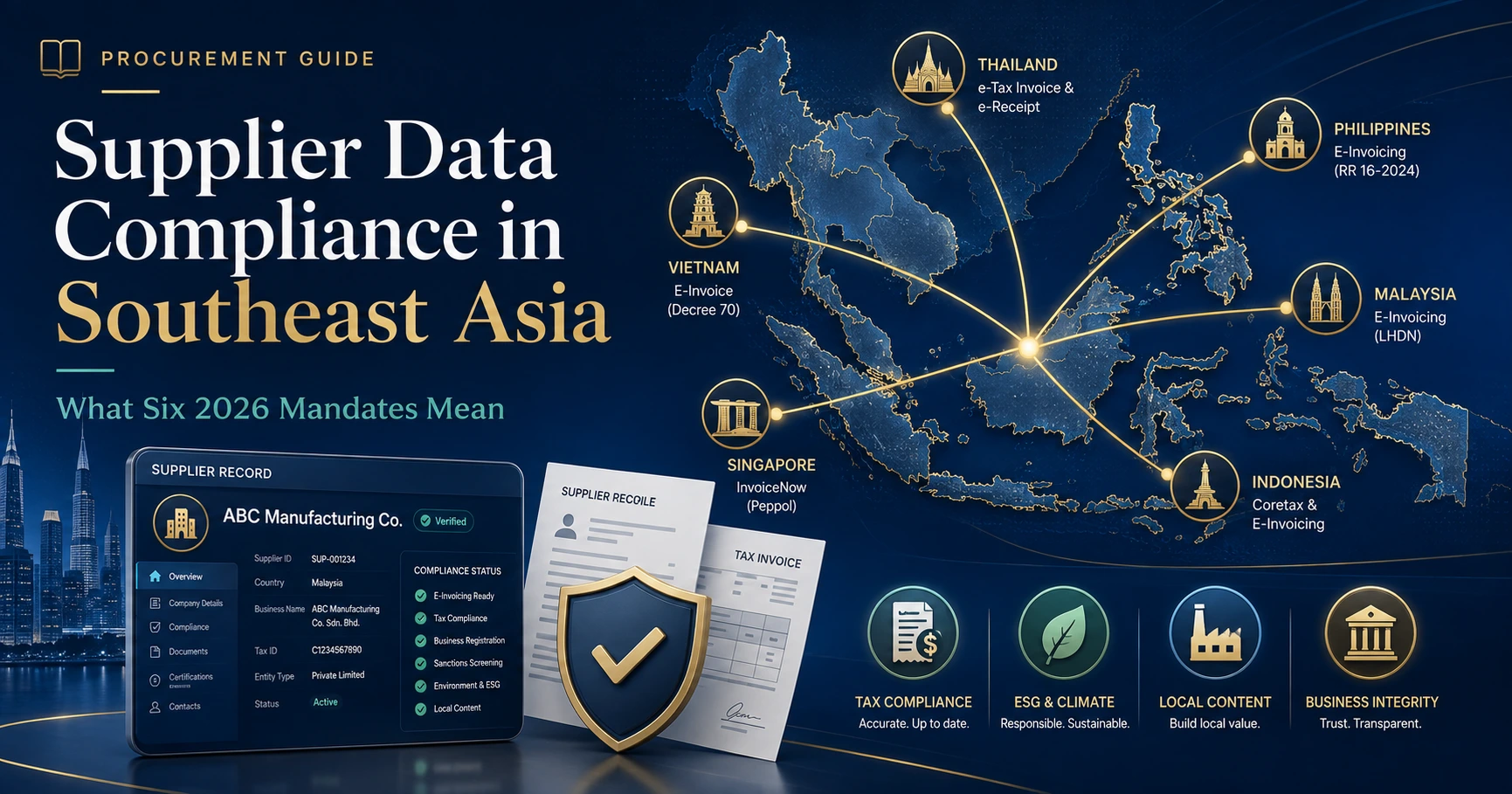
Six regulatory changes land across Southeast Asia and Hong Kong in 2026. Different regulators, different timetables, different languages, and one thing in common underneath: they all run on your supplier master data. If a supplier’s tax identifier, registered name, certification status or emissions data is wrong or out of date in your system, at least one of these mandates will fail because of it.
That is the whole argument. The rest of this article works through it market by market.
What is changing in 2026
| Market | Regulation | What it demands of the vendor record | When |
| Singapore | GST InvoiceNow | Peppol-ready identifiers for every entity you transact with | Mid-2026 notification |
| Malaysia | MyInvois | Validated TIN, SST registration and exact legal entity name | Live now |
| Philippines | BIR EIS (RR 26-2025) | Records clean enough for a three-day structured transmission window | 31 December 2026 |
| Hong Kong | HKEX ESG Code Part D | Scope 3 emissions collected from suppliers and defensible to an auditor | FY from 1 Jan 2026 |
| Indonesia | Coretax and TKDN | NPWP matched to your ERP name, certificates with live expiry dates | Live now |
| Thailand | e-Tax Invoice | Whatever your multinational customers write into contracts | Voluntary |
Three regimes, not six projects
The obvious move is to treat these as six separate workstreams owned by six local finance teams. That framing is usually what causes the overrun, because there are only three regimes at work.
- Real-time tax control. Invoicing used to be something you filed after the fact. Now it gets cleared, validated or reported while it happens.
- Mandatory climate disclosure. Scope 3 reporting has stopped being a voluntary sustainability exercise and become a listing requirement.
- Integrity and local content liability. These get answered from certificates and due diligence records you hold about other companies.
All three reach into the supplier record. None of them reaches the general ledger first.
Why supplier master data is the failure point
Real-time clearance is a matching problem
Under a continuous transaction control model the tax authority checks the counterparty against a national register before the transaction can complete. Malaysia’s MyInvois validates against the counterparty’s TIN, SST registration and registered name. Indonesia’s Coretax validates in real time, and if a supplier’s NPWP does not match the name your ERP holds, you cannot claim the input VAT until a replacement invoice has been issued and confirmed by both sides.
That second consequence is worth sitting with, because it is a procurement problem rather than a tax one. A stale supplier name in the vendor master turns into a blocked input VAT credit, which turns into a working capital problem. The tax team cannot fix it either, since the mismatch was created back at onboarding.
Scope 3 data does not exist inside your systems
HKEX Part D is modelled on IFRS S2, and Hang Seng Composite LargeCap constituents move to mandatory Scope 3 reporting for financial years starting on or after 1 January 2026. Other Main Board issuers are on comply-or-explain for now, with the cross-agency roadmap pointing at full HKFRS S1 and S2 adoption for large publicly accountable entities by 2028 at the latest.
Scope 3 Category 1 is purchased goods and services. If that data exists at all it sits with your suppliers, so collecting it, checking it and defending it to an auditor lands on whoever owns the relationship. Banks and insurers get Category 15 as well, covering financed emissions, which stretches the same collection problem across the whole portfolio.
Certificates are evidence with an expiry date
Section 17A of Malaysia’s MACC Act makes an organisation liable for corrupt acts by persons associated with it, and that definition stretches to agents and suppliers performing services on its behalf. The burden of proof runs the other way, and adequate procedures is the only statutory defence available. Third-party due diligence that is documented and kept current sits squarely inside it.
Indonesia’s Minister of Industry Regulation 35 of 2025 replaced the 2011 local content framework, brought TKDN and BMP certification together, and widened the Ministry’s authority to verify, audit and sanction. What gets audited is supplier certifications and traceable documentation.
In both cases the record you hold is not administrative. It is evidence, and it stops being valid on a date nobody has diarised.
Market notes for regional teams
Singapore. At Committee of Supply 2026 the government confirmed GST InvoiceNow will reach all GST-registered businesses by April 2031, starting April 2028, with IRAS notifying pre-2026 registrants of their date by mid-2026. Transitional grants run to $1,000 for SMEs and $5,000 for larger businesses needing ERP integration through an accredited Access Point. Singapore has the least urgent timetable in the region, and that is exactly the problem. Most regional procurement teams sit in Singapore, running five other countries’ deadlines from an office where nothing is due yet.
Malaysia. MyInvois has been rolling out by turnover since August 2024 and reached the RM1m to RM5m band in January 2026, with the permanent exemption threshold lifted to RM1 million. Relaxation windows have moved more than once, so check your own position with LHDN rather than a summary. Separately, GLCs, GLICs and PETRONAS put roughly RM49.2 billion into the Bumiputera agenda in 2025, most of it as vendor spend, against an annual commitment of around RM50 billion. Vendor spend is a reported number now, so it has to be classified to supplier, category and entity before anyone can disclose it.
Philippines. The nearest hard deadline in the region. RR 11-2025 originally put large taxpayers and users of computerised accounting systems on March 2026, and RR 26-2025 pushed that to 31 December 2026, with mandatory issuance from January 2027. Invoices have to be issued in the BIR’s JSON schema, with sales data transmitted to EIS inside three days. Sending a PDF does not meet the requirement. EIS certification and the Permit to Transmit apply to the mandated taxpayer rather than your software vendor, and accreditation routinely takes longer than teams allow for once multiple entities are involved.
Indonesia. Coretax replaced legacy e-Faktur as the primary VAT interface, with real-time clearance. SOE procurement policy is expected to track the new TKDN thresholds, pushing certification requirements down through every tier of the supply base.
Thailand. The e-Tax Invoice and e-Receipt system is still opt-in, with no legislated B2B mandate for 2026 or 2027. The deadline turns up commercially instead, through the contracts of multinational customers standardising across their whole supply base, and usually with far less notice than a regulator would give.
Where this bites first
Three sectors feel this earliest. Banking, financial services and insurance get Scope 3 Category 15 and supervised third-party risk expectations together, at onboarding volumes that turn due diligence into a scale problem. Government-linked and state-owned enterprises deliver their mandates through the vendor base itself and evidence them from the vendor record. Manufacturing, energy and logistics carry long multi-tier supply bases, heavy local content exposure and the biggest Scope 3 footprints, in sectors where one unqualified supplier can stall an entire project.
Six capabilities that answer all six markets
- One supplier record. A single deduplicated master per supplier covering legal entity, tax identifiers, ownership and status, certifications with expiry dates, category capability, performance and contract terms.
- Continuous risk sensing. Standing surveillance across financial stress, sanctions, ownership change, ESG breaches and adverse media, refreshed continuously rather than at review time.
- Qualification speed. A pre-qualified bench per critical category, and onboarding with a measured cycle time.
- Contract agility. Local content commitments, data obligations, payment terms and renewal dates that are queryable rather than filed.
- Continuous spend intelligence. Spend classified to category, supplier and entity as it happens.
- Evidence by process. Due diligence, document validation, approvals and data changes captured as an audit trail by the workflow itself.
The hard part is that every one of these needs continuous monitoring, current data and fast execution all at once, across thousands of suppliers in six jurisdictions. No regional team hires its way through that.
Score your own supply base
Six questions, scored 0 for no, 1 for partly, 2 for yes.
- Are tax IDs, status and expiries answerable from one screen in minutes?
- When a supplier’s position changes, do your own systems flag it first?
- Can you get a qualified alternative under contract in weeks rather than quarters?
- Can you identify within a day which agreements carry which obligations?
- Could you report spend by category and entity this week without reconciliation?
- If evidence were requested across a whole category tomorrow, is it an export?
0 to 3 Reactive. 4 to 6 Aware. 7 to 9 Prepared. 10 to 12 Governed.
Get the full guide
The full market-by-market breakdown is in the free guide, along with the regulatory detail behind each mandate, sector exposure notes and the complete self-assessment.
Download: A Southeast Asia Procurement Guide to Supplier Data in the Reporting Era
Frequently Asked Questions
Q1. Which Southeast Asia e-invoicing mandate has the nearest deadline?
The Philippines. Under RR 26-2025, covered taxpayers must comply by 31 December 2026, with mandatory issuance from January 2027.
Q2. Is MyInvois mandatory in Malaysia in 2026?
MyInvois has rolled out in phases by annual turnover since August 2024 and reached the RM1m to RM5m turnover band from January 2026. The permanent exemption threshold was raised to RM1 million, and relaxation windows have been extended more than once, so businesses should confirm their own position with LHDN.
Q3. Why does a supplier name mismatch block input VAT in Indonesia?
Coretax validates invoices in real time against the counterparty’s registered details. Where a supplier’s NPWP does not match the name held in the buyer’s ERP, the buyer cannot claim the input VAT credit until a replacement invoice is issued and confirmed by both parties.
Q4. Who has to report Scope 3 emissions in Hong Kong?
Hang Seng Composite LargeCap constituents report Scope 3 on a mandatory basis for financial years beginning on or after 1 January 2026 under HKEX Part D. Other Main Board issuers report on a comply-or-explain basis.
Q5. Does Thailand have a B2B e-invoicing mandate?
No. The e-Tax Invoice and e-Receipt system remains voluntary, with no legislated B2B mandate for 2026 or 2027. Requirements typically arrive through multinational customer contracts instead.