








Bringing AI agents in procurement workflow environments isn’t just about plugging a new tool into your ERP—it’s about changing how work actually gets done across your team. Many organizations jump into deployment expecting immediate savings, only to get bogged down by messy supplier data, rigid legacy software, or team hesitation. True success with agentic AI in procurement comes down to practical execution: establishing clear policy guardrails, ensuring smooth enterprise procurement AI integration, and giving software agents well-defined tasks to execute autonomously.
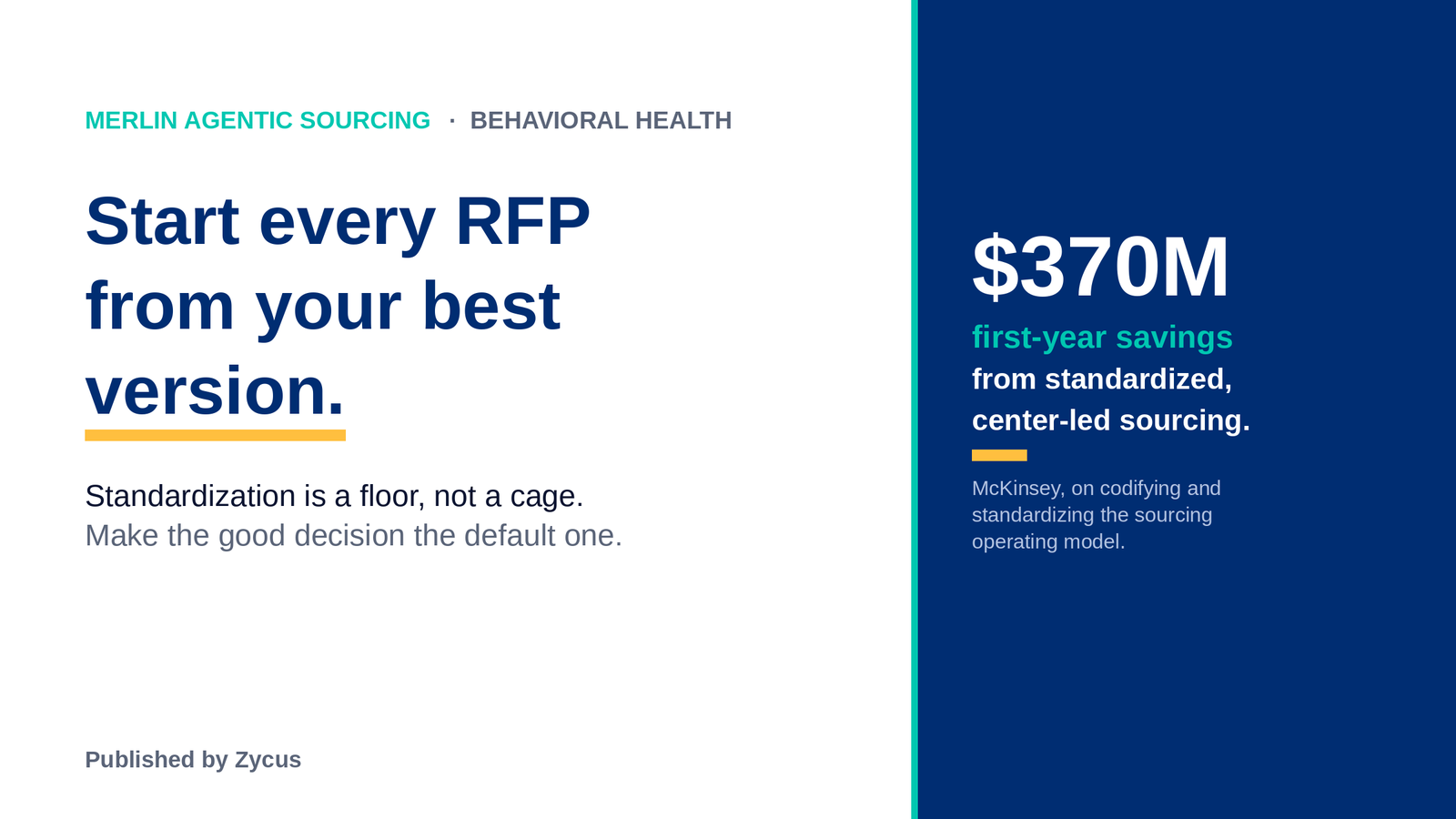
When you back your technology with a realistic AI procurement adoption strategy, your organization can transition toward reliable autonomous procurement workflows without sacrificing visibility or risk control. Most agent projects do not fail on the model. They fail on the fit: how well the agent slots into the work, the systems, and the people already in place.
TL;DR
- AI agent deployments succeed or fail on integration and fit, not on the underlying model.
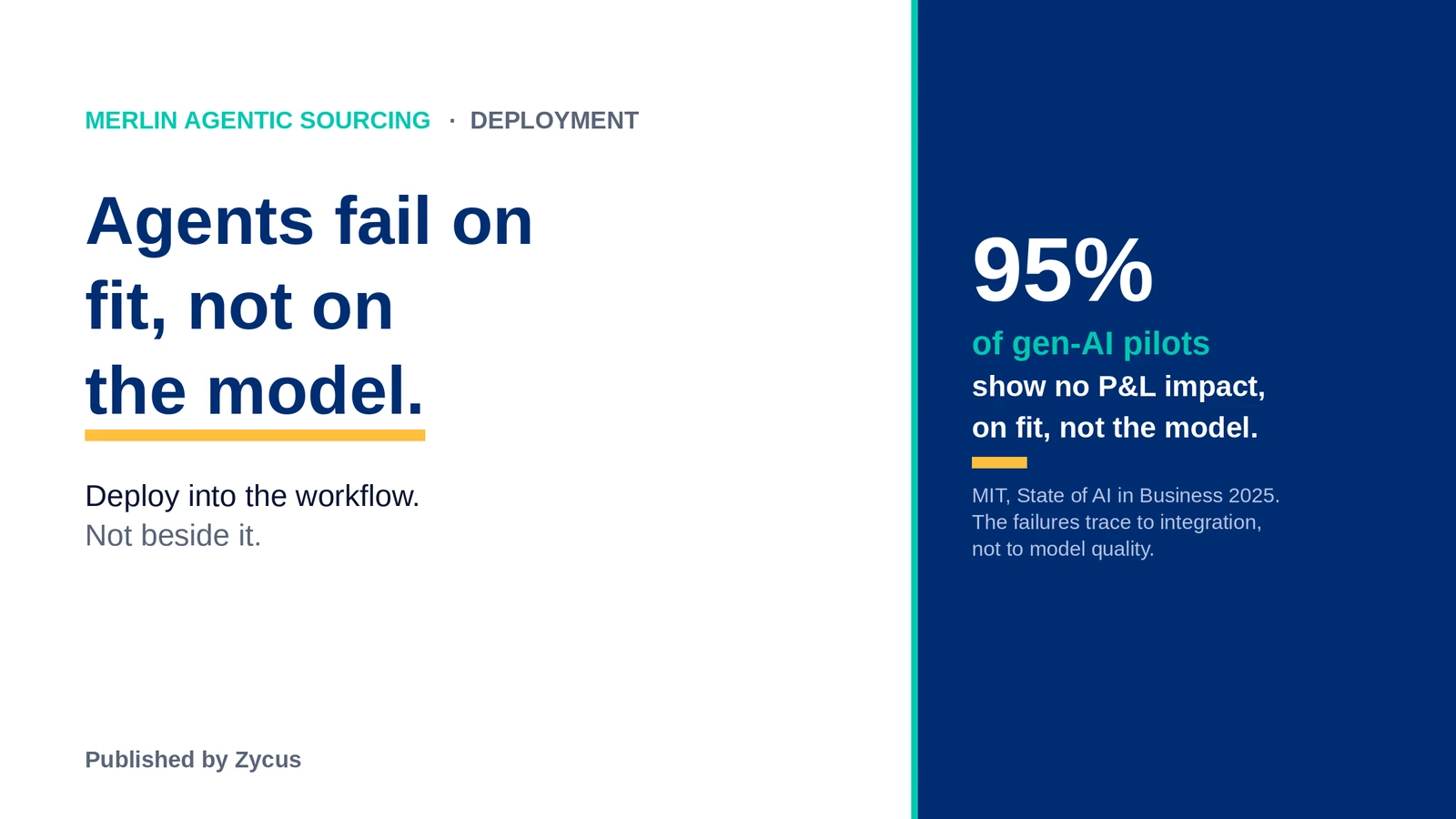
- MIT found 95% of enterprise gen-AI pilots deliver no measurable P&L impact, and the cause is integration, not the model.
- Most projects stall before production: McKinsey finds 62% of organizations experiment with agents but only 23% have scaled them.
- The common failure is applying an agent where a simpler tool would do, or bolting it beside the workflow instead of into it.
- Merlin Agentic Sourcing is designed to slot into the sourcing workflow and the systems around it, not to replace them.
Deploying an AI agent into procurement is less a technology decision than an integration one. The model is rarely the thing that decides whether the deployment works. What decides it is fit: whether the agent slots into the workflow people actually run, exchanges data with the systems already in place, and earns the trust of the team expected to rely on it.
Why do most AI agent deployments fail on fit rather than on the model?
Because the model is the part that is already solved well enough, and the fit is the part that is not. An agent that reasons impressively in a demo can still fail in production if it cannot reach the data it needs, if it produces outputs the existing systems cannot consume, or if the people around it do not trust it enough to hand over real work. MIT’s 2025 State of AI in Business study put a number on it: 95% of enterprise generative-AI pilots delivered no measurable impact on the P&L, and its authors traced the failures not to the quality of the models but to flawed enterprise integration, tools that never adapted to the real workflows and data around them.
The deployments that work start from the workflow and the systems, not from the model, and ask how the agent fits into what already exists. The instinct to lead with the model is understandable, since the model is the exciting part, but the deployments that pay off are the ones that treat it as the least of their worries.
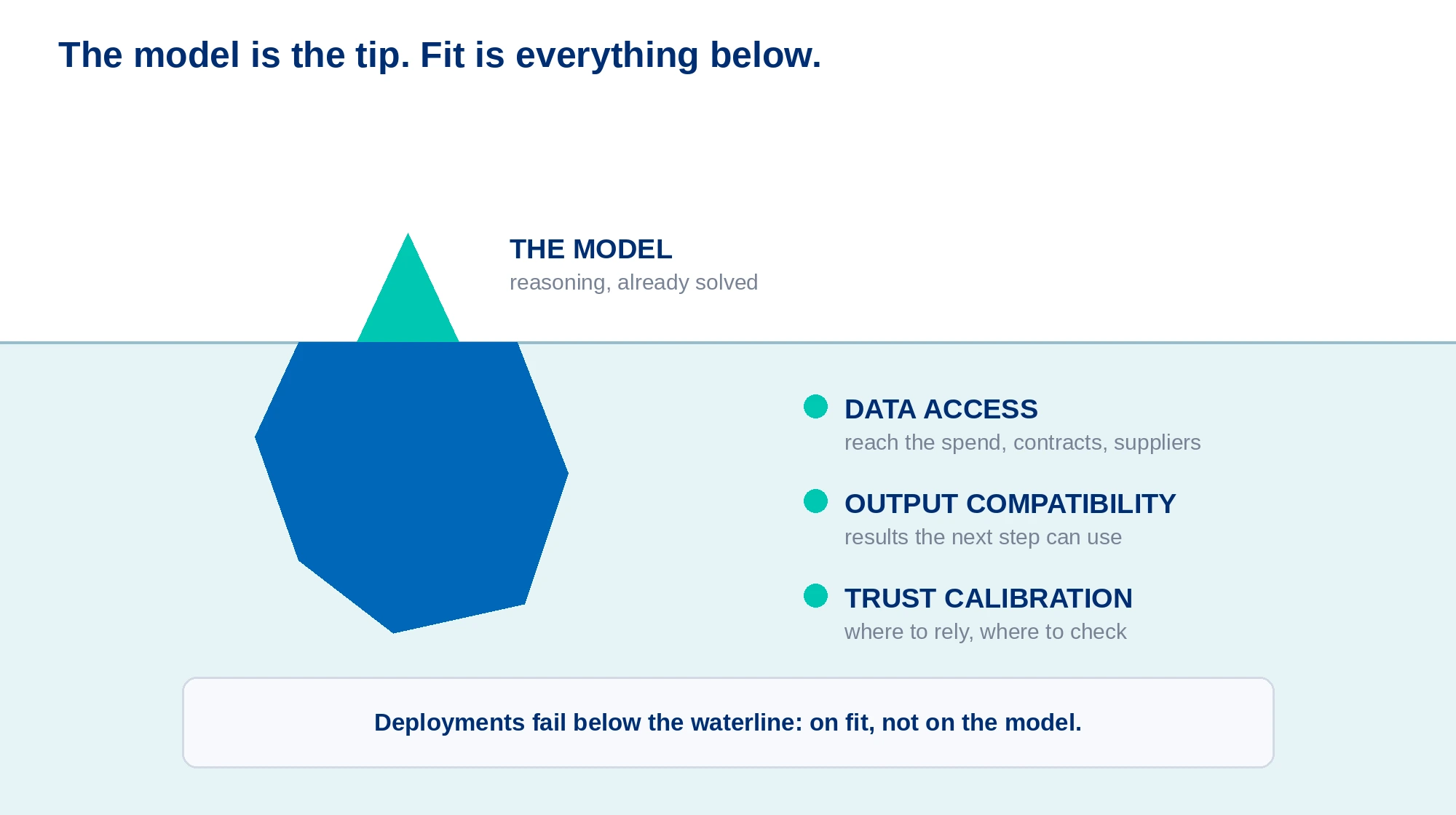
Figure 1. The model is the visible tip. What decides a deployment sits below the waterline: whether the agent can reach the data, produce usable output, and earn the team’s trust.
Is this still early, or is deployment already the mainstream question?
It is already mainstream, but adoption and deployment are very different things. The question facing most sourcing leaders is therefore not whether to deploy but how to be one of the 23%, and specifically how to avoid the common failure modes, agents that stall for lack of integration, or pilots that never scale because they were built beside the real workflow instead of inside it.
Being deliberate about deployment now is what separates the teams that get value from the ones that quietly shelve the project. Waiting for the technology to settle is no longer a neutral choice, because the teams deploying carefully now are building the integration and trust that later adopters will have to build under more pressure.
Read More A Complete Guide to Vendor Management – its Benefits, Challenges, Process & Best Practices
What does it mean to deploy an agent into the workflow rather than beside it?
Beside the workflow, an agent is a clever tool someone has to remember to open, feed, and then copy results out of. Into the workflow, the agent operates where the work already happens, drawing on the same data and producing outputs the next step can use directly. The difference is decisive. An agent beside the workflow adds a step, a place to paste inputs and retrieve outputs, and steps that depend on human diligence get skipped under pressure.
An agent inside the workflow removes steps instead of adding them, because its work lands in the flow rather than in a separate window. Deployment strategy is largely the work of moving the agent from beside to inside. The clearest sign of a beside-the-workflow deployment is a step in the process whose only purpose is to move data into or out of the agent, and every such step is a place the deployment can quietly fail.
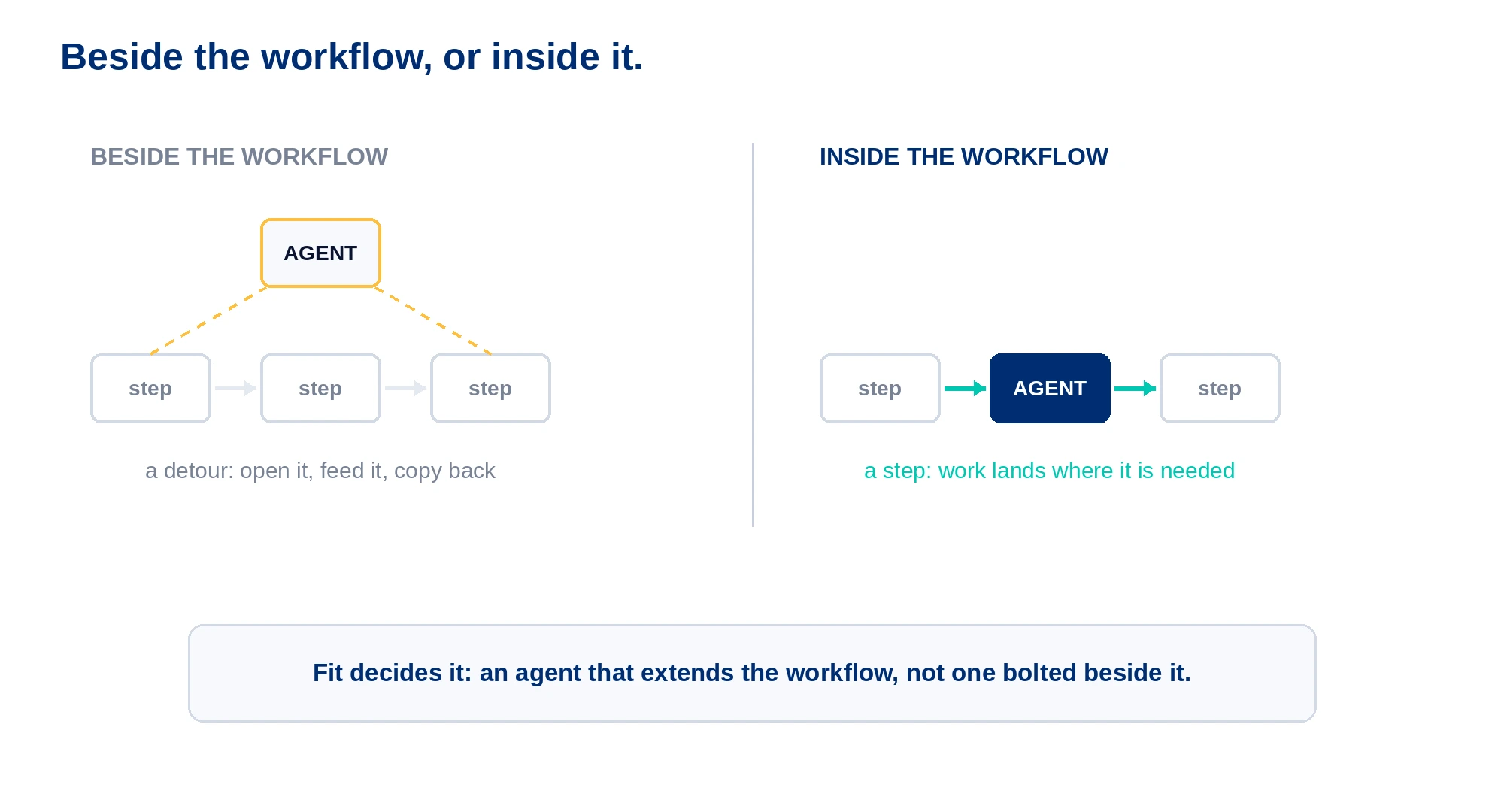
Figure 2. Beside the workflow, the agent is a detour that gets skipped under pressure. Inside the workflow, it is a step, and its work lands where the next step needs it.
Which parts of the deployment are usually underestimated?
Three, and all of them are integration, not intelligence. The first is data access: the agent needs the spend history, the contracts, the supplier records, and getting clean access to those across existing systems is most of the real work. The second is output compatibility: what the agent produces has to be consumable by the systems and people downstream, or it creates a reconciliation burden that erodes the time it saved.
The third is trust calibration: the team has to learn where to rely on the agent and where to check it, which takes deliberate exposure rather than a training slide. Underestimate these and the deployment stalls not because the agent is wrong but because it does not fit. None of these are glamorous, which is precisely why they are underestimated, and why the projects that respect them tend to be the ones still running a year later.
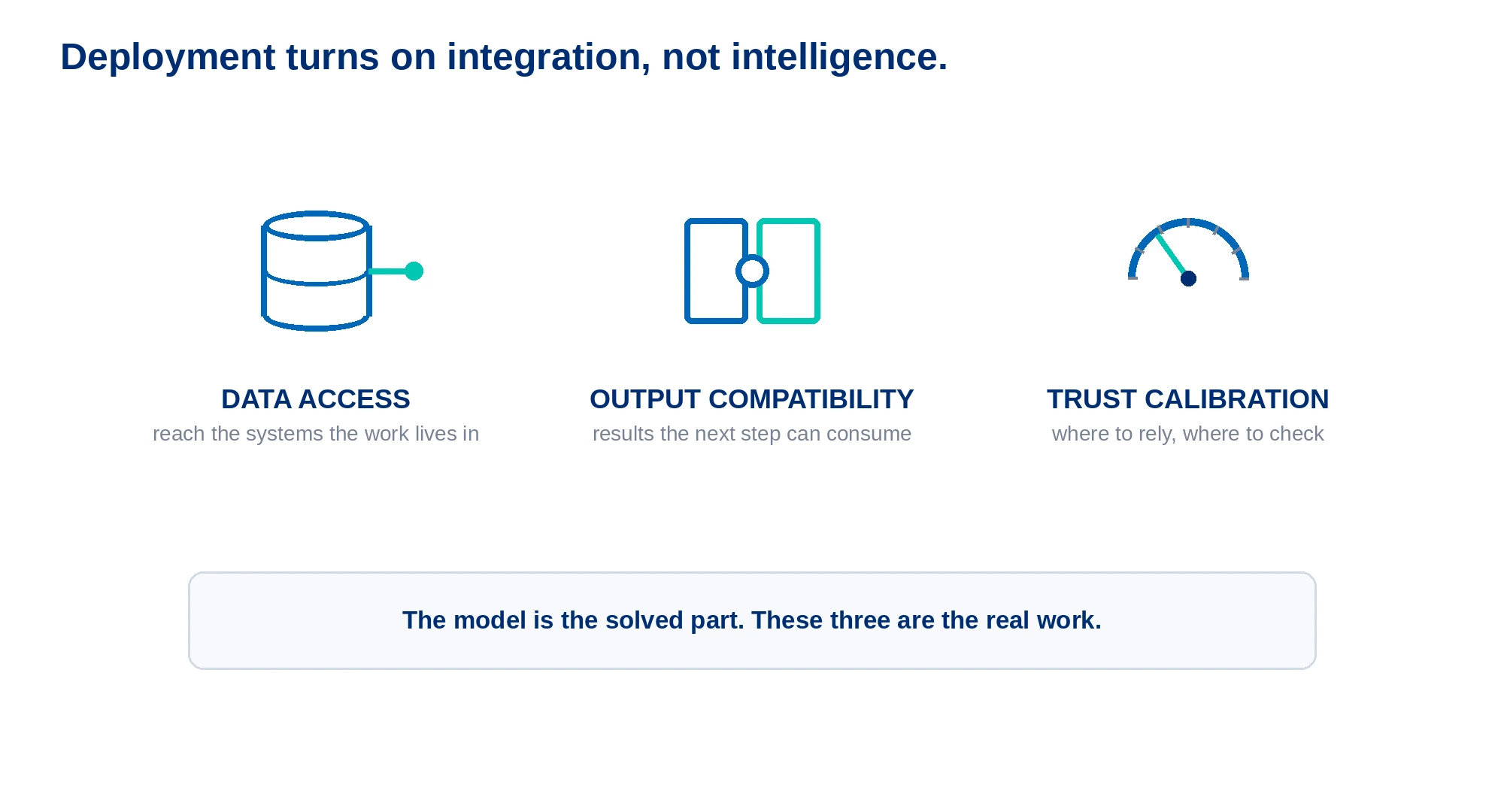
Figure 3. The three underestimated problems are all integration, not intelligence: reaching the data, producing consumable output, and calibrating where to rely on the agent.
How is agentic sourcing designed to slot into an existing workflow?
By running the sourcing work end to end on one data layer and preserving the human decisions that already exist in the process. Merlin Agentic Sourcing takes a business problem through analysis, supplier qualification, event authoring, and award modeling, and it keeps the consequential decisions, supplier selection, negotiation, award, as human checkpoints rather than removing them.
That design matters for deployment because it means the agent is extending the existing sourcing workflow rather than asking the team to adopt a new one alongside it. As a pre-launch product, its throughput figures are design-intent rather than proven results, so the deployment question is not the numbers but the fit: it is built to operate inside the sourcing process a team already runs, drawing on the same inputs and producing awards the organization can act on directly.
How should you sequence a deployment so it actually scales?
Start narrow, prove the fit, then widen. Pick one category where the data is reasonably clean and the stakes are moderate, deploy the agent into that real workflow, and confirm three things: that it can reach the data it needs, that its outputs are consumable downstream, and that the team trusts it enough to use it. Only once those hold should you extend to more categories.
The gap this discipline closes is real: Deloitte found that while 38% of organizations are piloting agentic solutions, only 11% have them running in production, and what separates the two is almost always the integration and trust work a narrow first deployment forces you to finish. The failure pattern is the reverse, a broad rollout that hits the integration and trust problems everywhere at once and gets abandoned. A narrow first deployment that genuinely works becomes the template and the internal proof that carries the wider rollout.
That fit is the reason a deployment succeeds or stalls, far more than any benchmark, because a tool that extends the existing process is one the team can actually absorb.
How do you build the team’s trust rather than assume it?
By exposing the agent’s reasoning and keeping humans on the consequential calls while trust is earned. People do not trust a black box that acts, and they should not. The workable path is to let the team see why the agent reached a recommendation, keep the human checkpoints on the decisions that commit the organization, and let reliance grow as the agent proves consistent on the lower-stakes steps.
Trust calibrated this way is durable, because it is based on observed behavior rather than a promise. Trust demanded up front is brittle, and the first surprising output breaks it. Deployment succeeds when the team ends up relying on the agent because it earned that reliance, not because they were told to. The organizations that get this right end up with a team that reaches for the agent by choice, which is a very different and far more durable outcome than a team that was mandated to use it.
Conclusion
Successfully embedding AI agents in procurement workflow operations ultimately hinges on balancing genuine autonomy with reliable governance. Setting up strong data foundations and practical execution parameters for agentic AI in procurement makes enterprise procurement AI integration feel like a natural evolution rather than a disruptive overhaul. As specialized AI tools, like Zycus Merlin for intake processing and ANA (Autonomous Negotiation Agent) for tail spend, take on multi-step tasks, executing a clear AI procurement adoption strategy is what turns automated software into a long-term strategic advantage.
Ready to upgrade your existing setup with safe, scalable autonomous procurement workflows? Request a demo today to see how Zycus embeds agentic AI right into your current supply chain ecosystem.
Frequently Asked Questions
Q1. What determines whether an AI agent deployment in procurement succeeds?
Fit, not the model. Success depends on whether the agent can reach the data it needs, produce outputs the existing systems and people can use, and earn the team’s trust. Deployments that start from the workflow and systems succeed; those that start from the model and bolt it beside the work tend to stall.
Q2. Is it too early to deploy AI agents in procurement?
No, but scaling one is still hard. McKinsey’s 2025 State of AI found 62% of organizations experimenting with AI agents yet only 23% scaling them, and MIT found 95% of enterprise gen-AI pilots delivered no measurable P&L impact. The mainstream question is how to deploy so it reaches production, not whether to deploy.
Q3. What does deploying an agent into the workflow mean?
It means the agent operates where the work already happens, drawing on the same data and producing outputs the next step uses directly, rather than sitting beside the workflow as a separate tool someone must open, feed, and copy results out of. Into the workflow removes steps; beside it adds one that gets skipped under pressure.
Q4. What parts of an agent deployment are most underestimated?
Three, all integration rather than intelligence: clean data access across existing systems, output compatibility so downstream systems and people can consume what the agent produces, and trust calibration so the team learns where to rely on the agent and where to check it. Underestimating these stalls deployments even when the agent works.
Q5. How should you sequence an AI agent rollout in procurement?
Start narrow. Deploy into one real workflow where the data is reasonably clean and stakes are moderate, confirm data access, output compatibility, and team trust, and only then widen. A broad rollout hits integration and trust problems everywhere at once and tends to be abandoned.
Q6. How does Merlin Agentic Sourcing fit into an existing sourcing workflow?
It runs the sourcing work end to end on one data layer and preserves the existing human decisions, supplier selection, negotiation, and award, as checkpoints. That means it extends the sourcing process a team already runs rather than asking them to adopt a separate one. Its throughput figures are design-intent as a pre-launch product.