








TL;DR
- ANZ believes a slower agentic AI curve is buying it protection. It is not. Caution changes when agent debt becomes visible, not whether it accrues.
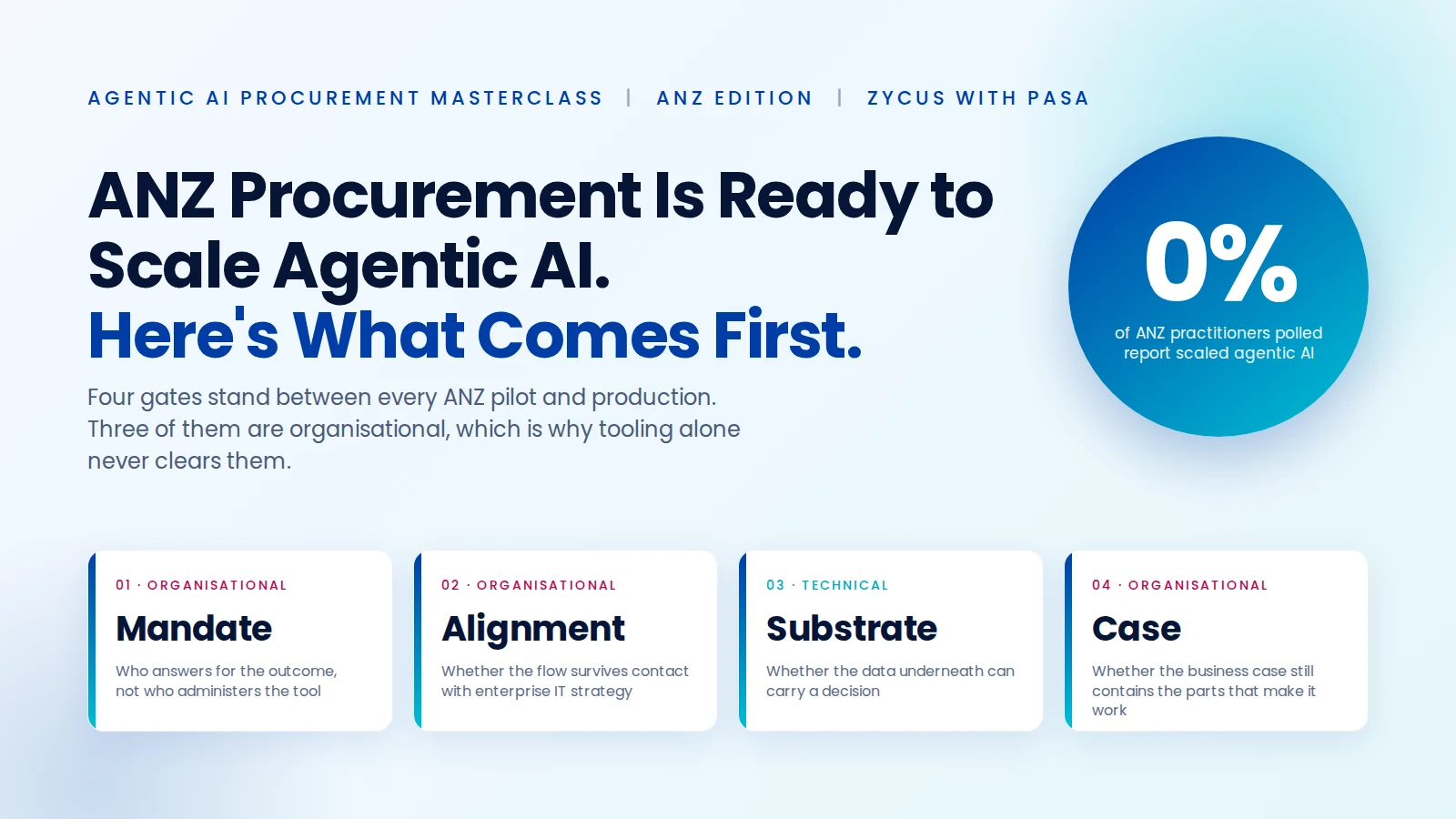
- Zero per cent of ANZ practitioners polled reported scaled agentic AI, while 16% already ran point agents in isolation. Slow adoption does not prevent agent debt, it only delays when you see it.
- ANZ ranks its risks differently from the global sample: data quality first, internal trust almost last. That inversion is diagnostic, not incidental.
- Four gates stand between an ANZ pilot and production: Mandate, Alignment, Substrate and Case. Three of the four are organisational, which is why tooling alone never clears them.
- The fix is not another pilot. Add residency to the five disciplines every agent already needs, and treat the governed flow as the unit of deployment.
The polling below comes from the ANZ edition of The Agentic AI Procurement Masterclass, run with PASA on 4 August 2026 for an audience of more than 150 Australian and New Zealand practitioners. Jonathan Dutton FCIPS moderated; Rachel Feenstra of Infosys Portland carried the framework and the practitioner view. This piece is the ANZ companion to The Shadow Agent Estate, which sets out the agent debt framework in full. It assumes you have read it, or will.
The appetite in this market is not in question. What is missing is the route from pilot to production. This article sets out what has to come first: the four gates every ANZ pilot has to clear, the one governance artefact this region needs that the global framework does not name, and six questions that tell you which gate is holding you. It starts with where ANZ actually stands, because the prerequisites only make sense against the real position.
Zero Per Cent Scaled: Where ANZ Procurement Actually Sits
Two years ago the conversation about agentic AI in procurement across Australia and New Zealand was aspirational. Someone demoed an intake agent, the room leaned forward, and the questions were about what it could do. The questions are different now. Who signed off. Who owns it when it misfires. Whether the data left the country.
So on 4 August we asked the room where their organisation sat. 51% were experimenting with pilots or individual tools and nothing in production. 25% had not started. 16% had point agents running in isolation with no central governance. 8% had agents inside orchestrated, governed workflows.
Nobody selected scaled. Zero per cent.
The ANZ CPO reading that will feel two contradictory things. Relief, because nobody is ahead. Then something colder, because 40% of the same audience would hand manual intake handling to an agent tomorrow if they could, the most-wanted use case in the room. This was not a room of sceptics. It was government agencies and large enterprises with a clear first use case and no route to production.
The evangelical phase in ANZ is over. What replaced it was not the production phase. It was a holding pattern that looks responsible from the inside.
Slow Adoption Does Not Prevent Agent Debt
There is a belief across this market that a slower agentic curve is itself a form of risk management, that piloting rather than deploying banks protection for later use.
There is no account it accrues in.
Agent debt is the compounding liability that isolated agents generate in risk, rework and spend. Caution does not stop it forming, because isolation is what generates it and isolation is cheap at any pace. What caution does add is a second cost that carries no invoice: every quarter spent proving rather than building widens the gap between what your estate can do and what your enterprise now asks of it. That gap produces no incident, so it surfaces only when someone asks the function to run a governed flow at volume and the honest answer is that nothing in the estate ever has.
The 16% with ungoverned point agents in production are the tell. They moved cautiously and accrued debt anyway.
Caution that is felt but never built is not caution. It is delay with a governance accent.
Why Agentic AI Adoption in ANZ Procurement Looks Different
Rachel Feenstra, NSW Director and Head of Global Procurement Excellence and Technology Practice at Infosys Portland, was unambiguous about the regional market. Australia is trialling widely and deploying narrowly, running point solutions aimed at specific problems rather than suites or platforms, and doing it in “a little bit more cautious way” than the rest of the world. Her second observation matters more: the caution is not a mood, it is a set of constraints that will not lift on their own.
Permission was answered by the CISO, not the CPO. Regulated and government organisations here settled early where data could live, which is why so many procurement teams hold one approved tool and an instruction not to upload to it. Feenstra was direct that this has not loosened. Nobody in this market is having “a free-for-all” across every tool, because the nature of contract, pricing, supplier and personal data does not allow it. Onshore data centres became the precondition for the conversation rather than a feature of it.
The individual workaround is already running. Dutton described an ANZ market at “sixes and sevens”: CIOs moving cautiously at the centre while individuals buy their own subscriptions on a corporate card and push working documents into environments nobody has inventoried. That is a shadow estate forming underneath a governance posture, and it is what our 16% in ungoverned production represent.
ANZ is not where the investment decision gets made. This was Feenstra’s sharpest structural point and the one most often missing from regional commentary. The industries where procurement holds real internal power, FMCG and retail, where cost of goods and inventory drive profitability, are headquartered in Europe and North America. ANZ runs regional entities at what she called the “back end of the world” rather than global head offices. The power dynamic is harder here, which is why a business case that clears a committee in Chicago or London stalls in Sydney or Auckland.
Procurement inherited its systems rather than choosing them. Dutton’s account of ANZ technology buying will be familiar: the enterprise buys an ERP for materials handling, procurement is invited late, and functionality gets haggled in at the end. Procurement was, in his phrase, “an afterthought.” Two decades of that produces the estate ANZ teams now hope AI will unify, and it arrives alongside what Feenstra called a two-speed economy: legacy systems carrying traditional maintenance costs underneath, an agentic layer accruing its own on top. Both speakers noted how fast AI control towers and dedicated governance roles have appeared on ANZ org charts, all of it inside the last six months.
ANZ caution is not a temperament. It is a structure, and structures do not respond to encouragement.
ANZ Ranks Its Risks in a Different Order
Asked for their single biggest concern about agentic AI over the next twelve months, ANZ practitioners put data quality and reliability first at 40%, with incorrect autonomous decisions almost level at 39%. Then the numbers fall off a cliff. Internal trust and adoption drew 7%. Uncontrolled spend 6%. No clear owner 5%. Supplier and compliance risk 4%.
Set that against the global picture in the parent research, where The Hackett Group’s polling found internal adoption and trust risk leading at 84% of respondents, ahead of incorrect autonomous decisions at 74% and data quality at 72%.
The order is close to reversed. ANZ practitioners are not worried that colleagues will refuse to use agents. They are worried the data underneath will make the agents wrong. That is a market which has resolved the adoption question and now doubts its own foundations.
It also explains why ownership registers so weakly here, at 5%. Globally, 34% of procurement leaders name lack of ownership for outcomes as a live constraint on deployment. In a market that has not put agents into governed production at scale, nobody has met that accountability gap in person yet. It is exactly the pattern the parent research warns produces the largest ledger later.
Check How DECCA Transformed Procurement with Zycus in Melbourne
Where Australia and New Zealand Sit on the Maturity Ladder
The whitepaper’s maturity ladder runs L0 unaware that agents are proliferating, L1 aware but unable to list them, L2 inventoried with a named owner each, L3 governed, and L4 centrally observable and outcome-embedded.
Map the 4 August poll onto it and the region resolves into an uncomfortable shape. The 51% experimenting sit at L1. The 16% running isolated agents in production added capability without climbing the ladder. 8% reached L3. L4 is empty.
Roughly nine in ten ANZ respondents sit at L1 or below, or in ungoverned production. That is not the reading a cautious market expects of itself.
Note what the ladder does not measure. Architecture beats agent count: the 16% did not climb a rung by adding agents, and the 8% did not need more of them to get there.
A dividend you cannot draw on is not a dividend.
Why ANZ Accrues the Debt Anyway
The parent post explains why shadow estates form: isolation is the default output of every path to agent creation, and Zycus accrued its own estate internally before it built the answer into Merlin’s architecture. That mechanism is universal. What is regional is the shape of the excuse.
One practitioner in the session described the ANZ version better than we have. AI implementation in large organisations here comes down to either telling the procurement team the company has a co-pilot licence and asking them to be productive with it, or hiring an AI implementation manager with a loose remit to do something useful. Both are reasonable responses to real uncertainty. Neither produces a governed flow, and both feel like progress for about three quarters.
The correction is architectural rather than commercial. In the Merlin Agentic Platform an agent is not a deployable unit. The flow is. Every agent participates in a governed multi-agent flow from the moment it exists, inside the Intake-to-Outcomes architecture, because an agent that can be deployed alone eventually will be.
Read More About: Agent Debt: The Tech Debt of the Agentic Era
The Four Gates Between an Agentic AI Pilot and Production
The four ledgers in the parent research describe where agent debt collects once agents are running. The four gates below describe why ANZ programmes rarely get far enough to accrue it.
- Mandate is the question of who answers for the outcome, not who administers the tool. It fails when ownership sits with whoever ran the pilot, which means it sits with nobody once that person changes role. It fails a second way when the remit is real but unbounded: the manager who can be blamed for everything and therefore decides nothing.
- Alignment is the question of whether your flow survives contact with enterprise IT strategy. Feenstra named both failure paths. Either the business case does not get over the line, or the build gets blocked because it will not integrate natively with what the rest of the organisation is doing. Procurement rarely gets to forge its own agentic path and keep the funding.
- Substrate is the question of whether the data underneath can carry a decision. This is the gate ANZ respondents named themselves. Feenstra put the limit bluntly: technology is an enabler rather than a panacea, and where the data is absent no tooling rescues the outcome. Only 46% of Australian and 39% of New Zealand organisations have a platform-led approach to integration, on Boomi and Omdia research across more than 1,100 Asia-Pacific decision-makers.
- Case is the question of whether the business case still contains the parts that make it work. Feenstra described ANZ cases trimmed until business integration, domain expertise, change management and governance had all been stripped out, leaving system integration alone. That case rarely delivers, because the tool’s way of working lands on an established process with no support behind it.
Three of the four gates are organisational. One is technical. Vendors only ever offer to help with the one.
Two Forces Closing the Window Specifically in ANZ
The parent research sets out the global pressure: the inversion moving procurement work into agentic flows, and boards that fund outcomes rather than activity. Both apply here. Two more are regional.
Your buyers are asking the governance question before your regulators do. Neither country has a standalone AI Act. Australia’s National AI Plan, released in December 2025, leans on existing laws and sector regulators instead, although the Government accepted in principle the case for mandatory guardrails in high-risk contexts in its April 2026 response to the Senate select committee. New Zealand’s July 2025 AI Strategy explicitly rejects an AI Act and positions the country as a light-touch adopter nation. None of that reduced the pressure; it relocated it into procurement. The Commonwealth’s AI procurement guidance and impact assessment requirements are mandatory for federal agencies and signal the direction for everyone selling to them, distinguishing high-risk from low-risk applications and placing more weight on data residency than comparable overseas regimes. 80% of Australian executives told Fujitsu’s Uvance Wayfinders survey that strong data sovereignty is essential to scaling AI, while only a minority have it embedded by design. ANZ procurement will be asked to assure agentic governance in a bid response before any statute requires it internally.
The consolidation cycle is running now. 85% of Australian and 84% of New Zealand organisations say they are actively reducing tool sprawl. Ungoverned point agents do not survive those reviews, because nobody can produce an owner or a measured outcome for them. An agent with no meter is an agent with no defence at renewal.
ANZ is not behind because it moved slowly. It is behind because slow was mistaken for governed.
Residency: The Sixth Discipline ANZ Has to Add
The parent research is clear that every agent needs five things attached at creation: an owner, a scope, a meter, a log and a kill switch. Those are not negotiable and they are not restated here.
ANZ deployments need a sixth, because our buyers and our regulators ask for it directly and neither accepts a verbal answer.
Residency is a documented statement of where the data sits and which jurisdiction processes it at inference time, written before the first transaction rather than after the first audit. It has to name the jurisdiction, not the vendor. It has to cover inference and not only storage, because a model hosted offshore processing onshore data is the exact gap a tender question is designed to find. And it has to be per agent, because the answer changes the moment one agent calls a service another does not.
Feenstra’s framing was that onshore data centres are why this conversation is possible in ANZ at all. Residency is the artefact that proves it.
Six Questions ANZ Procurement Should Answer This Week
The parent research carries the ten-question shadow estate audit and you should run it. These six are different questions, aimed at the gates rather than the ledgers, and specific to this market.
- Can you name the jurisdiction that processes your contract, pricing and supplier data at inference time, for each live agent?
- If your next major tender asked how your procurement AI is governed, could you answer it from existing documents rather than writing something new?
- Is your agentic roadmap the one your enterprise IT function would recognise, or a parallel one built because theirs was slow?
- Does your business case still contain the change management, domain expertise and governance line items, or were they cut to clear the committee?
- Was the investment decision for your procurement technology made in this region, and if not, who do you need in the room?
- Of everything running today, how much could survive a tool-consolidation review on evidence of a named owner and a measured outcome?
Two or more unanswerable questions means agent debt is already accruing in your function.
The first action is not a purchase and it is not a policy. It is a count: one honest list of every agent running in your name, with its owner, what it can reach, what it costs, and whether it sits inside a governed flow or in isolation. Then take the agent closest to production and produce all six artefacts for it, residency included. That tells you which gate is holding you, and it takes days rather than quarters.
Caution Was Never the Problem. Architecture Is the Answer.
ANZ procurement did not err by being careful. It erred by treating care as a substitute for architecture, and the region now holds the governance conviction without the governance artefacts. Filling an empty L4 does not require moving faster or deploying more agents, because architecture beats agent count. It requires changing the unit of deployment from the agent to the flow, and writing down the residency answer before somebody asks for it in a bid.
Read The Shadow Agent Estate for the ledgers, the failure modes and the full audit. The free Agentic AI Field Guide covers the vocabulary in seven modules. Or bring your estate to a session with our ANZ team and we will walk your closest-to-production agent through all four gates.
The Merlin Agentic Platform and its governed multi-agent flows are part of Zycus’s Intake-to-Outcomes architecture for governed, multi-agent procurement.
Frequently Asked Questions
Q1. Does adopting agentic AI slowly protect procurement from agent debt?
Adopting agentic AI slowly does not protect procurement from agent debt. Agent debt is generated by isolation rather than by pace, and isolated agents are cheap to create at any speed. At the ANZ masterclass on 4 August 2026, zero per cent of Australian and New Zealand practitioners polled reported scaled agentic AI, while 16% already had point agents running in production with no central governance. Those organisations moved cautiously and accrued debt anyway. Caution changed when the exposure became visible, not whether it existed.
Q2. How many Australian and New Zealand procurement teams have scaled agentic AI?
Among Australian and New Zealand procurement teams polled on 4 August 2026, none had scaled agentic AI. 51% were experimenting with nothing in production, 25% had not started, 16% were running point agents in isolation without central governance, and 8% had agents operating inside governed workflows. Mapped to the agent estate maturity ladder in the Shadow Agent Estate research, roughly nine in ten respondents sit at L1 or below, or in ungoverned production, with L4 empty.
Q3. Why is agentic AI adoption in ANZ procurement more cautious than in other regions?
Agentic AI adoption in ANZ procurement is more cautious for structural reasons rather than cultural ones. Permission questions were settled early by CISOs and data-residency requirements rather than by procurement leaders, so many teams hold one approved tool and cannot upload to it. Rachel Feenstra of Infosys Portland also noted that the industries where procurement holds the most internal influence, FMCG and retail, are headquartered in Europe and North America, leaving ANZ running regional entities rather than the offices where investment decisions are made. That power dynamic is harder here.
Q4. What worries ANZ procurement most about agentic AI?
ANZ procurement worries most about data quality and reliability, named by 40% of respondents, with incorrect autonomous decisions almost level at 39%. Internal trust and adoption drew only 7%. That is close to the reverse of the global picture in the Shadow Agent Estate research, where internal adoption and trust risk led at 84% of respondents. ANZ has largely resolved the adoption question and now doubts its data foundations, which is consistent with high appetite, low production and no scaled deployments.
Q5. What are the four gates between an agentic AI pilot and production?
The four gates between an agentic AI pilot and production are Mandate, Alignment, Substrate and Case. Mandate asks who answers for the outcome rather than the tool. Alignment asks whether your flow survives contact with enterprise IT strategy, because a flow that diverges from it either fails the business case or gets blocked on integration. Substrate asks whether the data underneath can carry a decision. Case asks whether the business case still contains the change management, domain expertise and governance that get trimmed to clear an investment committee. The gates sit before the four ledgers of agent debt, which describe what accrues once agents are already running.
Q6. Where should data residency sit for an ANZ procurement AI deployment?
Data residency for an ANZ procurement AI deployment should be documented before the first transaction, not after the first audit. The document has to name the jurisdiction rather than the vendor, cover inference and not only storage, and exist per agent. Procurement data carries contract terms, pricing, supplier records and personal details, and 76% of Australian organisations report concerns about data sovereignty requirements. Commonwealth AI procurement guidance sets residency and impact-assessment expectations for federal agencies, and enterprise tenders increasingly ask suppliers the same question.