








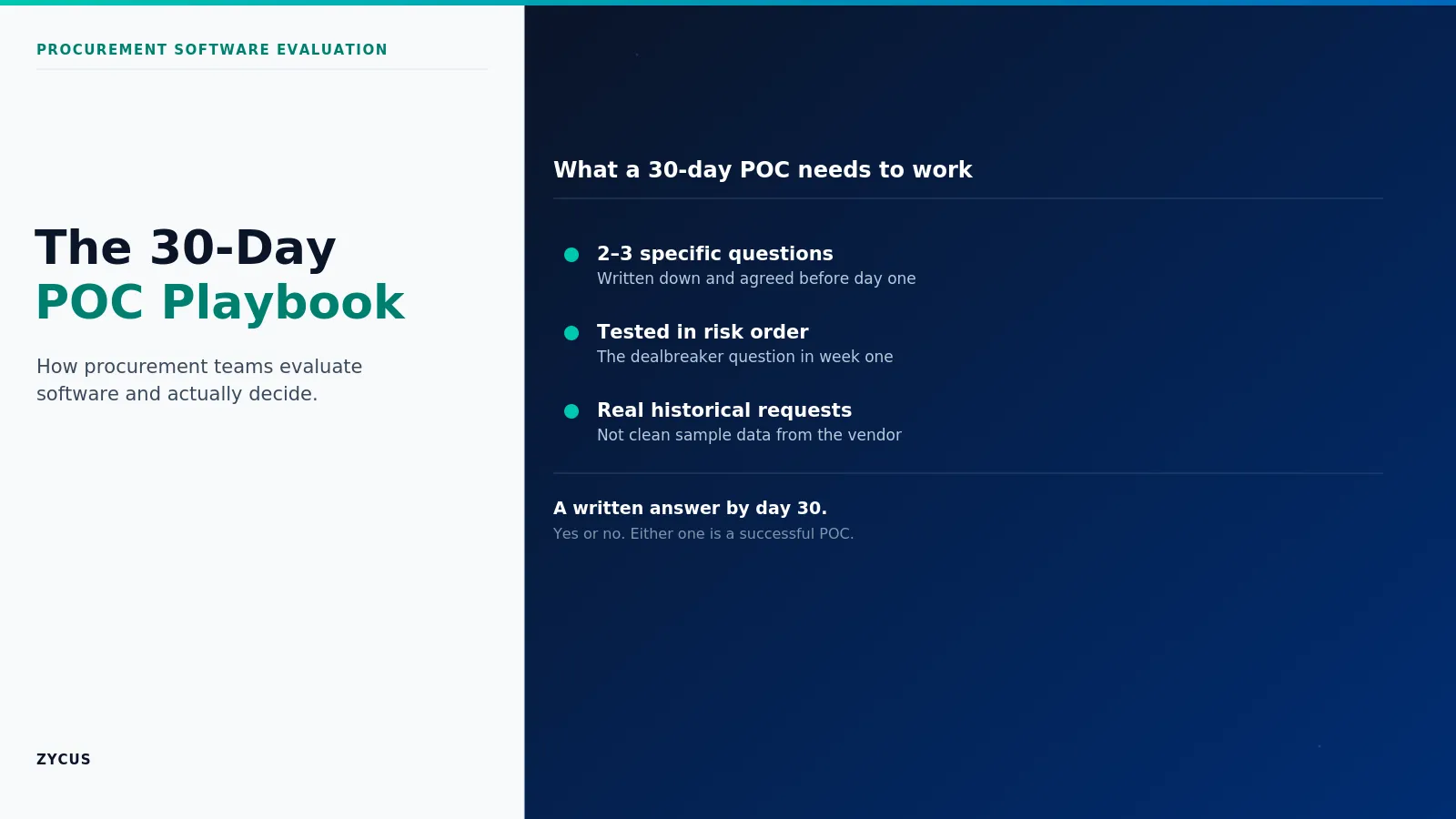

Most procurement POC end without a clear decision. Not because the software failed, but because nobody scoped the 30 days around the actual question blocking the buying committee.
TL;DR
- A procurement POC scoped around a feature tour produces impressions, not a decision. A POC scoped around two or three specific unresolved questions produces one.
- Before day one, name the questions in writing and get the buying committee to agree those are the ones that matter, not a list generated after the fact to justify a decision already made informally.
- Structure the 30 days around answering those questions in order of what would kill the deal fastest, not around a vendor-provided demo script.
- Deloitte’s 2025 Global CPO Survey: organizations combining technology and talent investment hit cost-savings targets 96 percent of the time, against 80 percent for those that had not, a gap that starts with how seriously the evaluation itself was run.
- A POC that ends in “we liked it” without a written answer to the original questions is not a completed POC. It is an extended demo.
- See how a structured POC actually gets scoped against your specific requirements. Request a demo →
Not because the software failed. Most enterprise procurement tools can genuinely do most of what they claim in a controlled demo. POCs end inconclusively because nobody scoped the 30 days around the specific question actually blocking a decision, so 30 days of activity produces a list of impressions, some positive, some not, with no way to tell whether any of them are decisive.
A feature tour cannot fail. Every checkbox gets checked, every screen gets shown, and the buying committee leaves with a favorable general impression and nothing written down that resolves the actual disagreement that made an evaluation necessary in the first place.
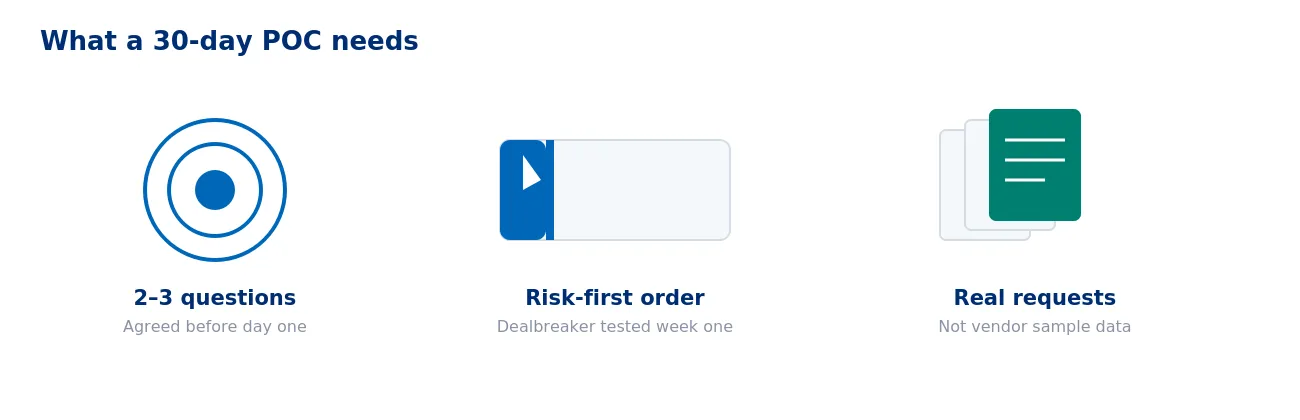
Why do so many POCs end without a clear decision?
Because the 30 days get scoped around what the vendor wants to show rather than what the buyer needs to know. A vendor-led demo script is optimized to look impressive across the full breadth of the platform, every module, every screen, a comprehensive tour that leaves almost nothing untouched. A buying committee usually has one or two genuine points of disagreement, whether the routing logic handles a specific edge case, whether adoption will actually happen given how the last tool landed, whether the integration effort is real or optimistic, and a broad feature tour rarely resolves either one directly, because breadth and depth pull in opposite directions inside the same 30 days.
The result is a POC that technically ran to completion, generated a positive general impression, and still leaves the room divided on exactly the question that made an evaluation necessary in the first place. Nobody can point to what specifically was learned, because nothing specific was actually tested.
What questions should a POC actually be scoped around?
The ones the buying committee is genuinely divided on, not the ones that are easy to demonstrate. If finance is worried about integration effort and procurement is worried about adoption, the POC needs to produce evidence on both, specifically, not a general sense that the product seems capable. Write the questions down before the POC starts and get explicit agreement from whoever has to sign off that these are the questions that matter, not a longer list that sounds thorough but dilutes attention away from the two or three that would actually change the outcome.
A POC that answers questions nobody was actually asking has succeeded at the wrong task. It is worth being ruthless here: two or three real, specific, genuinely contested questions produce a better evaluation than ten broad ones that read well in a project plan but do not map to anyone’s actual hesitation.
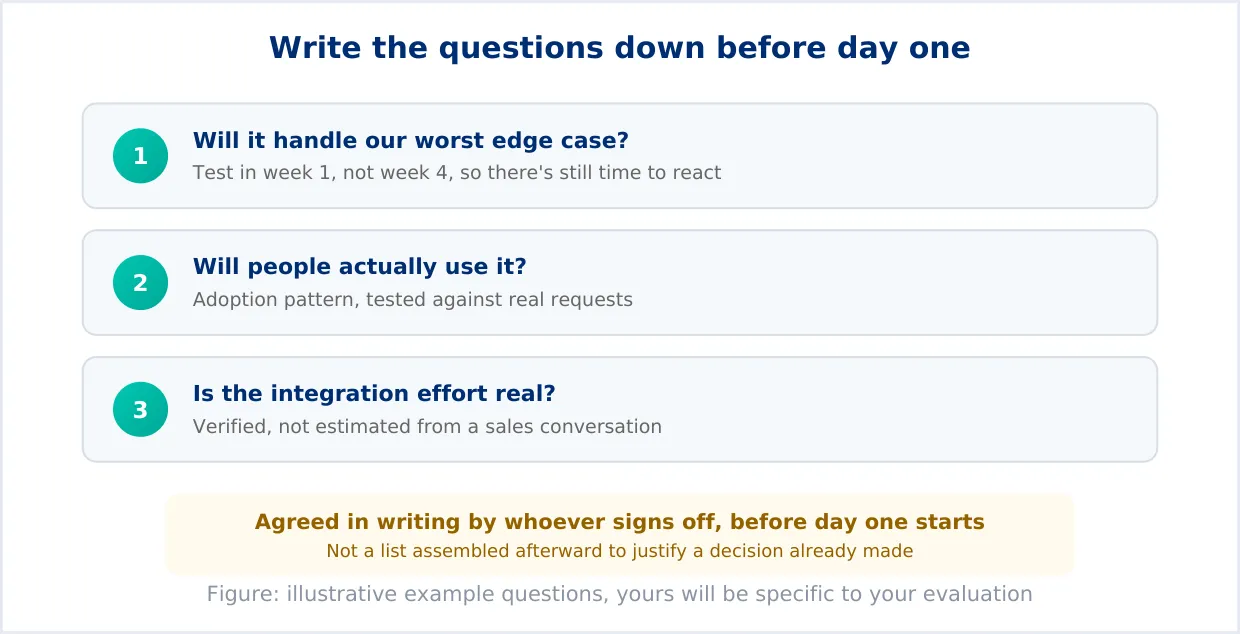
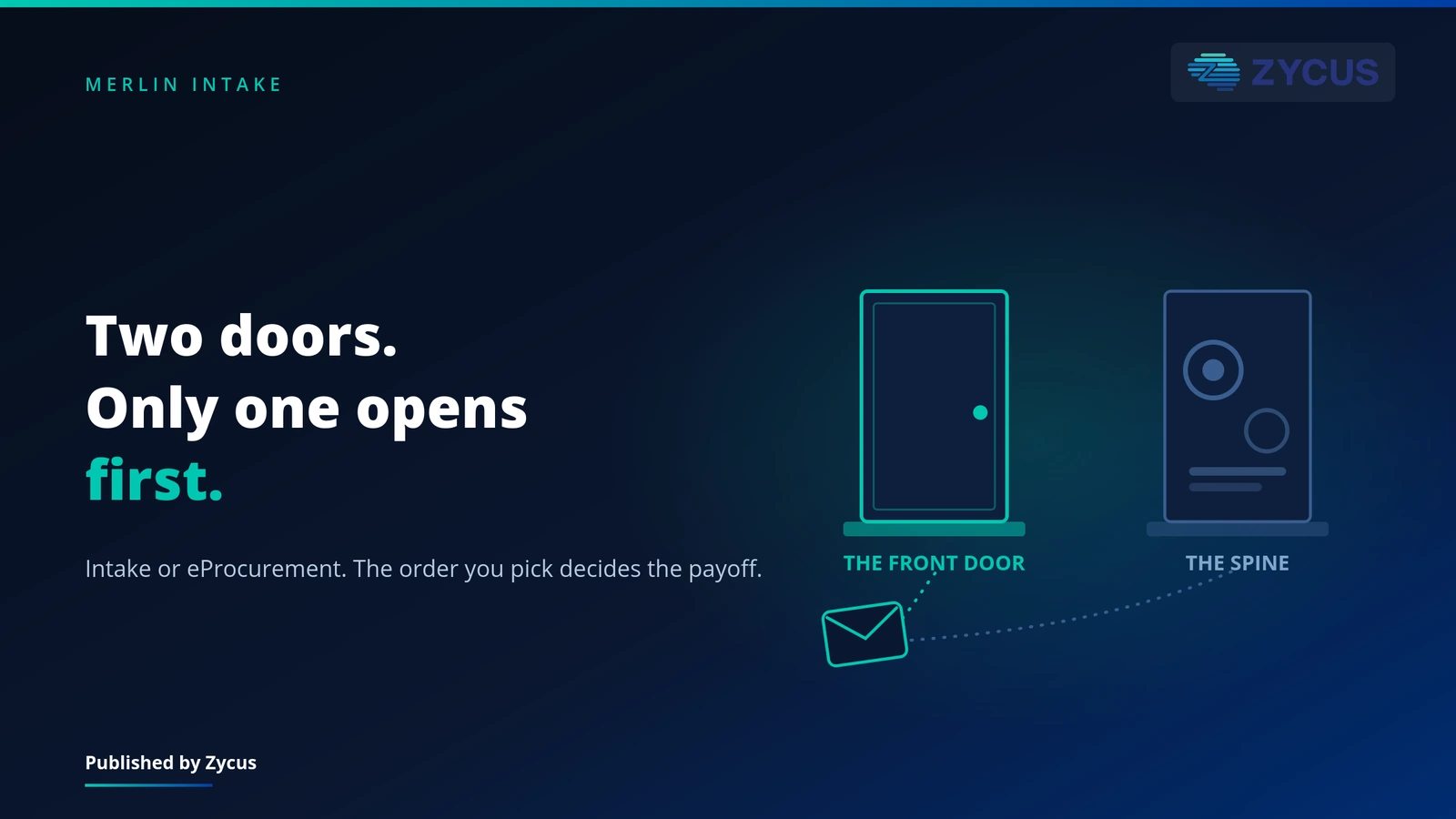
Figure 1: name the questions before the 30 days start, not after.
How do you structure the 30 days around real questions?
Sequence by what would kill the deal fastest if the answer came back wrong. If integration is the make-or-break question, test that in week one, not week four, so there is still time to course-correct or walk away before the evaluation has consumed a month. Reserve the back half of the 30 days for the questions that matter but are not existential, adoption pattern testing, workflow fit for edge-case categories, reporting depth. A POC structured this way can fail fast and cheaply on the question that actually matters, instead of failing slowly on schedule after every feature has already been demonstrated.
McKinsey research found that 40 percent of procurement functions have already implemented or piloted generative AI.
That figure is specifically about generative AI adoption, not procurement technology piloting in general, but it is evidence that structured piloting, evaluating something specific before committing broadly, is already the norm for at least this category of decision, which is the same discipline a well-scoped 30-day POC applies.
What data do you need before day one?
Real requests, not sample data the vendor provides. A handful of actual recent purchase requests, spanning the categories where the disagreement actually lives, gives the POC something concrete to route, categorize, and match against, rather than a clean synthetic dataset that was never going to surface the messy edge case the buying committee actually cares about. Pulling this together before day one is the single highest-leverage prep step, and the one most often skipped under time pressure, usually because gathering real historical requests takes more coordination than exporting a vendor-provided sample file.
How does Merlin Intake fit into a 30-day POC?
A POC against Merlin Intake works best scoped the same way: pick the specific categories and edge cases the buying committee is actually divided on, route real historical requests through it, and compare the routing and policy decisions against what actually happened at the time. Because Merlin Intake runs on the Merlin Agentic AI Platform, a POC scoped this way also surfaces how intake decisions would have flowed into sourcing and AP, not just whether the intake screen itself looks reasonable in isolation.
Hackett Group’s 2026 Procurement Key Issues research found 76 percent of organizations report AI-driven improvements of 25 percent or more once adoption scales past initial pilots.
That is a finding about scaled adoption, not about the POC stage specifically, but it is a useful reminder of the gap between the two: a 30-day POC is measuring early signal, not the full outcome, and should be scoped to produce a confident decision rather than a final performance number.
What does a successful POC actually prove?
That the specific questions written down on day one have specific, written answers by day 30, whichever direction those answers point. A POC that ends with the buying committee still debating the same open question it started with has not succeeded just because the 30 days elapsed without incident. Elapsed time is not the same as resolved uncertainty, and a POC’s only real job is resolving uncertainty on the questions that were actually blocking a decision, nothing more and nothing less than that.
Where does a 30-day timeline not work?
When the real blocker is not a product question at all, budget approval, a competing internal project, an unrelated reorganization, no amount of well-scoped product evaluation resolves it, and running a POC anyway just produces a technically successful evaluation that still cannot convert into a decision. It is worth confirming the blocker is actually a product question before committing 30 days to answering one.
Frequently Asked Questions
Q1. How long should a procurement software POC take?
Thirty days is a common and reasonable window for most evaluations, long enough to test real requests against real questions, short enough to keep momentum and avoid the evaluation becoming its own ongoing project.
Q2. What makes a POC fail to produce a decision?
Being scoped around a general feature tour rather than the specific questions the buying committee is actually divided on, which produces broad positive impressions but no answer to the disagreement that made an evaluation necessary.
Q3. Should a POC use real data or vendor-provided sample data?
Real historical requests, ideally from the categories where the buying committee’s disagreement actually lives. Sample data is built to demonstrate the product cleanly, not to surface the edge cases an evaluation is supposed to test.
Q4. Who should be involved in scoping a POC?
Whoever has to sign off on the eventual decision, agreeing in writing on the specific questions the POC needs to answer before it starts, not after results are already in hand.
Q5. What should happen in the first week of a 30-day POC?
Testing whichever question would kill the deal fastest if it came back unfavorably, so there is still time to course-correct or end the evaluation early rather than discovering a dealbreaker in week four.
Q6. Can a POC succeed even if the answer is no?
Yes. A POC that produces a clear, evidence-based no is more successful than one that produces a vague, unresolved maybe, since both took the same 30 days but only one actually resolved the original uncertainty.
Q7. Does Merlin Intake support a 30-day proof of concept?
Yes, structured around the specific categories and edge cases relevant to a buying committee’s actual open questions, using real historical requests rather than generic sample data.
Q8. What if the real blocker to a decision is not about the product?
A well-run POC cannot resolve a non-product blocker like budget approval or a competing internal priority. It is worth confirming the blocker is genuinely a product question before committing 30 days to answering one.