








A procurement intake rollout is easy to mistake for configuration work. It is closer to operating-model design. The technology can route a request in seconds, but it can only apply the policies, ownership rules, supplier logic, and exception paths the organization has made clear enough to automate.
A practical procurement intake process therefore works best in stages: map the policy people actually follow, test it in a contained pilot, expand with evidence, then scale procurement orchestration across categories, business units, and downstream workflows. The sequence is not an industry law. It is a useful implementation model because each phase gives the next one better inputs.
TL;DR
- A practical four-phase procurement intake implementation starts with policy mapping, moves to a contained pilot, expands in waves, and then scales across the enterprise.
- Do not automate the policy manual until you have reconciled it with how approvals, preferred suppliers, thresholds, and exceptions actually work today.
- McKinsey reports that 40% of procurement functions have implemented or piloted generative AI. That shows pilot-based adoption is already widespread, but it does not prove one universal rollout sequence.
- The Hackett Group reports that 76% of organizations see AI-driven improvements of 25% or more in key performance metrics as adoption scales. The finding applies to procurement AI broadly, not to intake alone.
- The pilot category should be frequent enough to generate real usage data and contained enough that mistakes are cheap, not the easiest category or the most political one.
- Two Zycus customers, CEWA and IFF, are currently mid-rollout on exactly this sequence, at different phases.
What does a procurement intake implementation roadmap look like?
The purpose of a procurement intake roadmap is not to switch on every feature. It is to move demand into a governed front door without breaking the policies and buying paths the business relies on. In practice, the work usually falls into four connected phases.
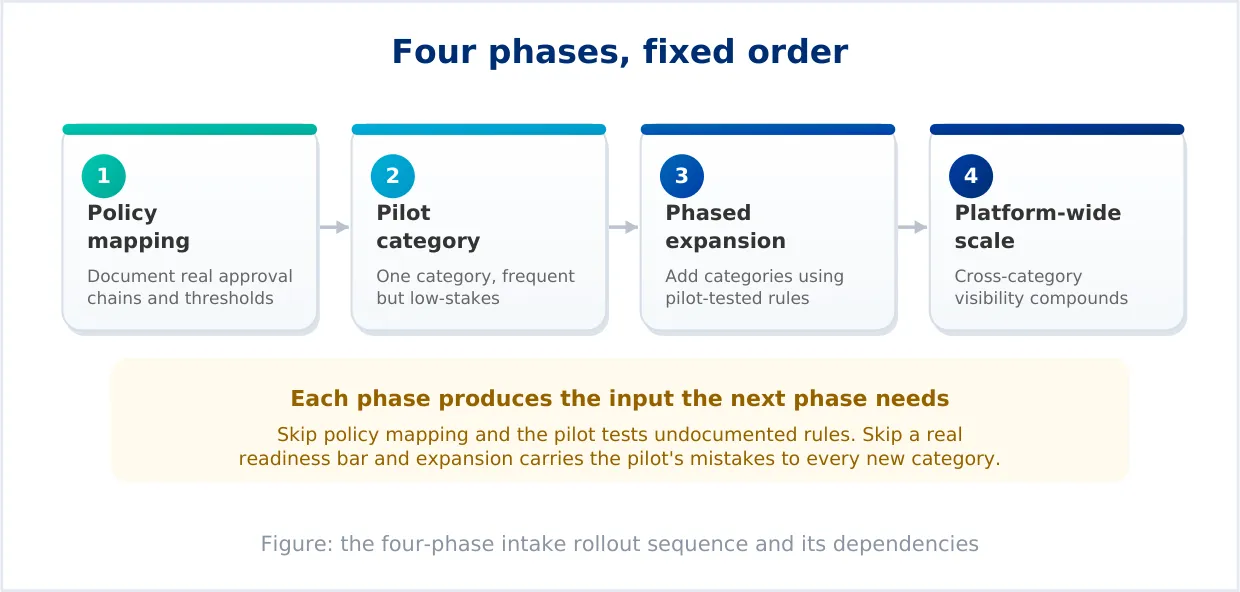
Four-phase procurement intake roadmap at a glance
| Phase | Goal | Core work | Exit criteria |
|---|---|---|---|
| 1. Policy mapping | Create a trustworthy rule base | Map actual approvals, thresholds, preferred suppliers, catalogs, exception owners, regional differences, and system dependencies. | Business and procurement agree that the mapped rules reflect current practice, not only documented policy. |
| 2. Pilot category | Test the procurement intake process with real demand | Choose a category with enough request volume to expose edge cases, but low enough risk that mistakes are easy to correct. | Users adopt the channel, routing is reliable, and recurring exceptions have a known root cause. |
| 3. Phased expansion | Extend what worked without copying it blindly | Add categories, business units, or regions in waves. Revalidate local policies and integrations before each wave. | New waves meet the same readiness bar without rising manual overrides or user workarounds. |
| 4. Enterprise scale | Turn intake into procurement orchestration | Connect demand visibility with sourcing, supplier management, contracts, P2P, analytics, and emerging agentic workflows. | Most eligible demand enters a governed channel and outcomes can be measured across categories and regions. |
This framework is intentionally gate-based. A phase is complete when it produces what the next phase needs, not simply because the project plan says the date has arrived.
Phase 1: Map the policy people actually follow
Before configuring procurement automation, map the rules that determine where a request should go. That includes approval chains, spend thresholds, preferred suppliers, contracted categories, catalog coverage, new-supplier rules, budget ownership, and the people who can approve an exception.
This is where many teams discover policy drift. A threshold was changed informally but never updated. A preferred-vendor list still contains suppliers nobody uses. An approval rule exists on paper, while the real decision has been delegated for years. If a routing engine is configured against stale documentation, the pilot may appear to be wrong when the underlying problem is that the policy no longer reflects practice.
Implementation readiness checklist before configuration
- List the request types and categories the new intake channel will cover first.
- Confirm current approval thresholds and who actually exercises approval authority.
- Map preferred suppliers, contracts, catalogs, and the rule for creating a new supplier.
- Define who owns exceptions and what evidence is needed to approve one.
- Identify regional, legal, business-unit, or currency variations before building one global rule.
- Document the systems that must receive or return data, including ERP, S2P, contracts, supplier management, and collaboration tools.
- Capture baseline metrics such as request volume, manual touches, cycle time, off-channel requests, and reroutes so improvement can be measured later.
The point is not to create a perfect policy library before launch. It is to remove the contradictions that would otherwise be automated at scale.
Phase 2: Choose a pilot category that can teach you something
A pilot should create evidence, not comfort. McKinsey reports that 40% of procurement functions have implemented or piloted generative AI, which shows how common pilot-based adoption has become across procurement. The more important question is what the pilot is designed to learn.
A category that is too simple may generate clean metrics without testing real approval or supplier complexity. A category that is politically sensitive, operationally critical, or full of disputed ownership can turn the pilot into a governance negotiation before the routing logic has had a fair test.
Look for a middle ground: enough demand to produce patterns within weeks, a manageable number of stakeholders, known suppliers or buying channels, and consequences that are reversible if a request is misrouted. Office IT peripherals, routine facilities requests, and selected marketing services can fit that profile in some organizations, but they are examples, not a universal shortlist.
APQC reports that organizations spend from about $14 to more than $54 to process a single purchase order. That benchmark is useful context for why process design matters, but it should not be treated as the direct cost of every intake routing error.
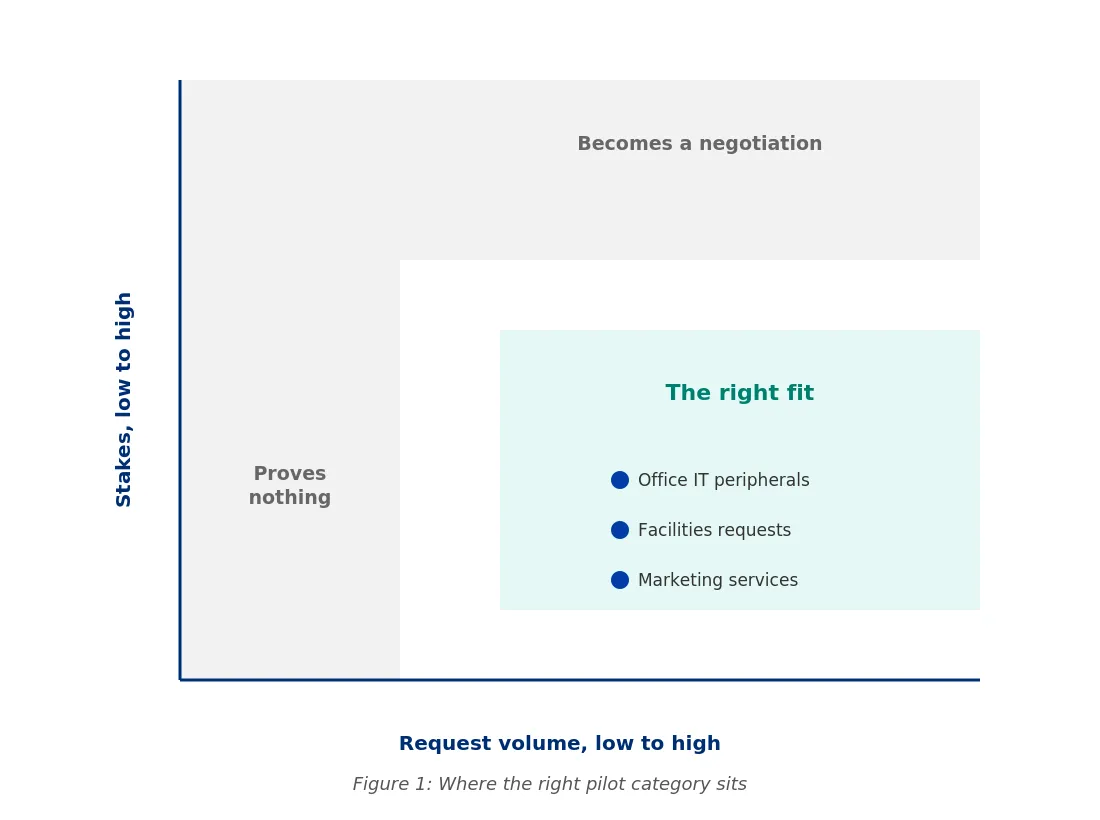
Pilot category scorecard: pick a pilot that can teach you something
| Criterion | Good pilot signal | Warning sign |
|---|---|---|
| Request volume | Enough eligible requests to reveal patterns and exceptions quickly. | So little volume that the pilot can look perfect without being tested. |
| Business risk | Errors are visible and fixable without disrupting critical operations. | A single routing error can stop production, delay a critical service, or trigger escalation. |
| Policy clarity | Core rules are understood, with a few useful edge cases to test. | Stakeholders disagree on who owns the category or what approval should apply. |
| Supplier landscape | Preferred channels and supplier rules are known well enough to test routing. | The category is already in the middle of a major sourcing or supplier-governance dispute. |
| User behavior | A reachable user group can provide fast feedback and has real demand. | The pilot group is too small, too atypical, or has an incentive to keep using email and informal channels. |
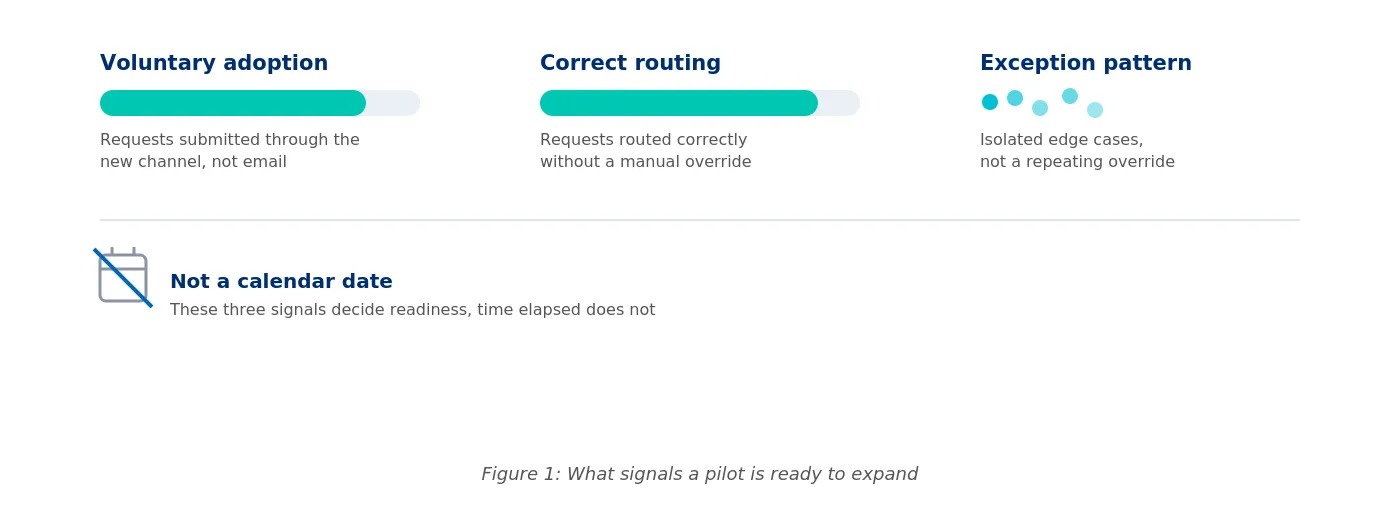
How do you know a pilot is ready to expand?
Not by time elapsed alone. Before the pilot starts, define a small set of readiness measures and agree on what improvement would justify the next wave. There is no single percentage that works for every organization, but the measures themselves should be consistent.
- Voluntary adoption: what share of eligible requests enters the new intake channel instead of email, chat, spreadsheets, or direct buyer intervention?
- Correct routing: what share of requests reaches the intended path without a manual reroute or policy correction?
- Exception pattern: are exceptions isolated edge cases, or is the same override appearing every week?
- Cycle time: is the median time from request submission to the next valid procurement step improving?
- Manual touch: how often does procurement have to repair information, reclassify a request, or chase an approver before the workflow can continue?
A repeated exception is especially useful. It usually points to a rule, data, integration, or policy gap that should be corrected before expansion. Scaling the same exception only makes it more expensive to diagnose later.
Phase 3: Expand in waves, not by copying the pilot
Once the pilot is stable, phased expansion should reuse what was learned without assuming every category or region behaves the same way. The core procurement intake process can stay consistent while approval thresholds, tax rules, supplier constraints, language, budgets, and risk controls vary locally.
This is where procurement orchestration becomes more important than simple intake capture. Each new category or business unit should inherit the common front door and governance model, but its routing should still reflect the right sourcing, contracting, supplier, and P2P path for that demand.
A useful expansion wave has a defined owner, a known population of eligible requests, a short list of local policy differences, baseline metrics, and the same readiness gate used for the pilot. If every wave invents a new success definition, platform-wide reporting becomes meaningless.
Phase 4: Scale procurement orchestration, not just access
The Hackett Group’s 2026 Procurement Key Issues research reports that 76% of organizations see AI-driven improvements of 25% or more in key performance metrics as adoption scales. The research covers procurement AI broadly, so it should not be read as proof that intake alone produces those gains. It does reinforce a useful implementation principle: value changes when adoption moves beyond isolated experiments.
At enterprise scale, the benefit of procurement intake is not simply that more employees can submit a request. It is that more demand becomes visible before it fragments across email, local workarounds, unapproved suppliers, or disconnected systems. Cross-category patterns also become easier to see, such as two functions buying similar services through different channels or repeated exceptions pointing to a policy that needs redesign.
Scale should therefore be measured by governed demand and downstream outcomes, not by licenses issued. If the business still routes a large share of eligible requests around the intake channel, the rollout is not finished even if every user technically has access.
Read More About Understanding the Future of Procurement: The Comprehensive Guide to the Intake Process
What real phased adoption looks like: CEWA and IFF
Large procurement transformations are being deployed in defined stages, with a current scope and a named next step.
| Customer | Public rollout evidence | What it shows |
|---|---|---|
| Catholic Education Western Australia (CEWA) | CEWA supports more than 78,000 students, 11,000 staff, and 150 schools. After an 18-month selection process, it implemented core S2C and P2P capabilities. Its next phase includes expanding Merlin Intake across the school network, with Agentic Sourcing and Autonomous Negotiation listed as future roadmap initiatives. | The public roadmap is phased. Intake expansion follows a broader procurement foundation rather than every capability being launched at once. |
| IFF | At DPW New York 2026, Zycus reported Merlin Intake live in 23 countries with 21 more in active deployment, more than $3B in spend under managed visibility, 91% of transactions completed in five days or fewer, and 300,000+ suppliers standardized into one view. Tail-spend negotiation is identified as a next capability. | Enterprise scale can happen in waves. A mature intake deployment can continue expanding geographically while the organization adds the next procurement automation use case. |
Use these examples as implementation evidence, not as a promise of identical timelines or outcomes. Organization size, policy maturity, integrations, data quality, category complexity, and change-management capacity all affect the path to scale.
How is an intake implementation roadmap different from a procurement transformation roadmap?
A procurement transformation roadmap is broader. It can span operating model, strategic sourcing, contracts, supplier management, procure-to-pay, payments, analytics, talent, data, and technology over multiple years. A procurement intake implementation roadmap is one layer inside that transformation. It focuses on how demand enters the function, how it is interpreted, and how it reaches the right downstream path.
That distinction matters because the two roadmaps move at different speeds. Intake can often be piloted and expanded while larger transformation work continues around it. At the same time, intake should not be designed in isolation from the systems and governance it must eventually orchestrate.
The cleanest model is to keep the enterprise transformation roadmap as the strategic frame, then use the four phases in this article as the implementation plan for the intake workstream.
Where do procurement intake rollouts most often stall?
The failure modes are usually more predictable than the technology problems. Five are worth watching closely:
- Automating stale policy: the configured workflow is technically correct but operationally wrong because the source rules were never reconciled with current practice.
- Choosing a low-signal pilot: the category is so simple or low-volume that the pilot produces reassuring metrics without testing the operating model.
- Expanding on a fixed date: the next wave starts even though routing overrides or recurring exceptions are still unresolved.
- Treating local variation as user resistance: a region or business unit is bypassing the flow because a real policy or system dependency was missed, not because users refuse change.
- Measuring training instead of behavior: completion rates and logins look healthy while eligible requests continue arriving through email or direct buyer intervention.
The common thread is simple. A rollout stalls when the project plan advances faster than the operating model learns.
What should implementation teams measure at each phase?
| Phase | Core metric | What it tells you | Useful companion measure |
|---|---|---|---|
| Policy mapping | Policy reconciliation rate | How much of documented policy has been confirmed with current owners and actual practice. | Number of unresolved rule conflicts, exception owners identified, baseline off-channel volume. |
| Pilot | Eligible-request adoption and correct-routing rate | Whether users choose the new front door and whether the workflow sends demand to the intended path. | Median cycle time, manual touch rate, repeating exception rate, requester feedback. |
| Expansion | Wave stability | Whether each new category, region, or business unit meets the pilot readiness bar without a spike in overrides. | Local policy variance, integration errors, category coverage, off-channel leakage. |
| Enterprise scale | Governed demand coverage | How much eligible demand enters a measurable, policy-aware procurement channel. | Spend under management, cycle time, sourcing activation, preferred-channel usage, tail-spend coverage, requester satisfaction. |
Avoid turning these into vanity KPIs. The metric matters only if it changes a rollout decision: fix the rule, extend the pilot, pause the next wave, or scale with confidence.
How does Merlin Intake fit the implementation sequence?
Zycus positions Merlin Intake as an AI-powered front door that captures procurement requests in natural language, applies embedded policy, and routes demand into the appropriate workflow. It also describes third-party integration support and links intake with sourcing, supplier onboarding, negotiation, and other Source-to-Pay processes.
That architecture can support a phased rollout because teams can start with a defined request population and expand coverage over time. It does not remove the implementation work described above. The platform can execute a rule, but procurement still has to decide which rule is valid, who owns an exception, what counts as a preferred channel, and when a pilot is ready for the next wave.
For organizations with an existing S2P or ERP landscape, the practical question is not simply whether a full replacement is required. It is which systems remain systems of record, which workflows Merlin Intake will orchestrate, what data must move between them, and where governance decisions will live.
Want to see how Zycus can turn procurement intake into a governed path from request to outcome? Request a demo
Frequently Asked Questions
Q1. What is a procurement intake process?
A procurement intake process is the controlled way business requests enter procurement, gather the information needed for a decision, and route into the right buying path. Modern intake management can connect requests with catalogs, approvals, sourcing, supplier onboarding, contracts, and P2P workflows.
Q2. How long does a procurement intake implementation take?
There is no defensible universal timeline. A contained pilot can be timeboxed, but expansion should be gated by readiness rather than a fixed number of weeks. Organization size, policy maturity, integrations, regions, category complexity, and change-management capacity materially affect the schedule.
Q3. Can you skip the pilot phase if the configuration is already tested?
You can test configuration without a live pilot, but that does not reproduce real requester behavior, local workarounds, incomplete information, or policy exceptions. A contained live phase is valuable because it exposes operating-model issues before they are multiplied across the enterprise.
Q4. How do you choose the right pilot category?
Choose a category with enough eligible request volume to generate learning quickly, clear enough policy to configure a meaningful flow, manageable business risk, known supplier or buying channels, and a user group that can provide feedback. Avoid choosing a category only because it is easy.
Q5. What does a ready-to-expand pilot look like?
Users are voluntarily using the channel, routing is reliable, manual corrections are falling, recurring exceptions have been fixed or consciously accepted, and cycle time is stable or improving. Set the thresholds before the pilot so the expansion decision is not made retroactively.
Q6. Does a phased rollout work for global organizations?
Yes, but the shared process should allow local policy differences. A common intake front door can coexist with region-specific thresholds, suppliers, approvals, tax rules, and regulatory requirements. Expansion by business unit or region is often easier to govern than one simultaneous global switch.
Q7. How is procurement intake different from procurement orchestration?
Intake is the front door where demand is captured and understood. Procurement orchestration is the broader coordination of the systems, approvals, people, and downstream workflows that fulfill that demand. A mature intake process becomes the trigger for orchestration rather than an isolated request form.
Q8. Does Merlin Intake require a full Source-to-Pay replacement?
Not necessarily. Zycus lists third-party integration support for Merlin Intake and positions it as native to its Source-to-Pay suite. The right architecture depends on the existing ERP and S2P landscape, integration scope, systems of record, and the workflows the organization wants intake to orchestrate.
Sources and evidence used in this article
The Hackett Group, 2026 Procurement Key Issues: 76% of organizations report AI-driven improvements of 25% or more in key performance metrics as adoption scales. This is procurement AI evidence broadly, not an intake-only benchmark.
McKinsey, Transforming procurement functions for an AI-driven world: 40% of procurement functions report having implemented or piloted generative AI.
CEWA and Zycus procurement transformation announcement: public evidence of a staged Source-to-Pay deployment, followed by planned expansion of Merlin Intake across the school network and additional future AI-led capabilities.
IFF at DPW New York 2026: Zycus reports Merlin Intake live in 23 countries, 21 more in active deployment, more than $3B in spend under managed visibility, 91% of transactions completed in five days or fewer, and 300,000+ suppliers standardized into one view.