








Sourcing behavioral health services, specialized software, and clinical care partners requires balancing stringent regulatory mandates, patient privacy standards, and complex operational needs. Relying on ad-hoc questionnaires or generic sourcing tools introduces friction, delays care delivery, and heightens risk exposure. Implementing standardized rfp templates tailored to behavioral health allows procurement teams to establish consistent evaluation criteria, automate compliance verification, and accelerate vendor selection while maintaining the highest standards of care. Standardization is not about rigid forms. It is about making the good decision the default one, so every RFP starts from your best version, not a blank page.
TL;DR
- A standardized RFP template makes your best sourcing practice the default, so quality stops depending on who runs the event.
- Standardization is where value compounds: McKinsey documents standardized, center-led sourcing driving savings into the hundreds of millions.
- Behavioral health procurement adds real requirements: licensure, credentialing, privacy, and continuity of care that a generic template omits.
- The goal is a living template that captures what worked, not a frozen form nobody updates.
- Merlin Agentic Sourcing authors events from proven playbooks, so standardization is built into how the RFP is created.
A standardized RFP template is often mistaken for bureaucracy, a rigid form that slows people down. Done well, it is the opposite: it makes your best sourcing practice the default, so every event starts from your strongest version rather than a blank page or whatever the last person happened to reuse. The stakes are not small: Trilliant Health estimates the total cost of behavioral health conditions in the United States exceeds $300 billion a year, so how efficiently these organizations source the services and supplies behind that spending genuinely matters.
Why does a blank page cost more than it looks like it does?
Because every blank page reinvents decisions that were already made well once. When each buyer starts an RFP from scratch or from a random prior document, quality swings with whoever is running the event. One RFP asks the right qualification questions and scores them consistently; the next omits a licensure requirement or forgets a continuity-of-care clause. The cost is not just time. It is variance: some events produce strong, defensible awards and others produce weak ones, and the difference is often nothing more than which starting document the buyer happened to grab.
That waste is a luxury behavioral health can least afford: a 2026 workforce study in Psychiatric Services projects demand for adult psychiatric care will climb roughly 44% by 2037 even as the specialist workforce contracts, which means every hour lost to inconsistent sourcing is one a strained system needed elsewhere. A standardized template removes that lottery. It encodes the questions, the scoring, and the required clauses once, so the floor of quality rises for every event. Consistency is not the enemy of quality here; it is the mechanism of it, because a rising floor lifts every event rather than only the ones a strong buyer happens to run. Every reinvented decision is also a chance to reintroduce an error that a prior event had already solved, which is how variance compounds quietly across a year of sourcing.
What does standardization actually change about outcomes?
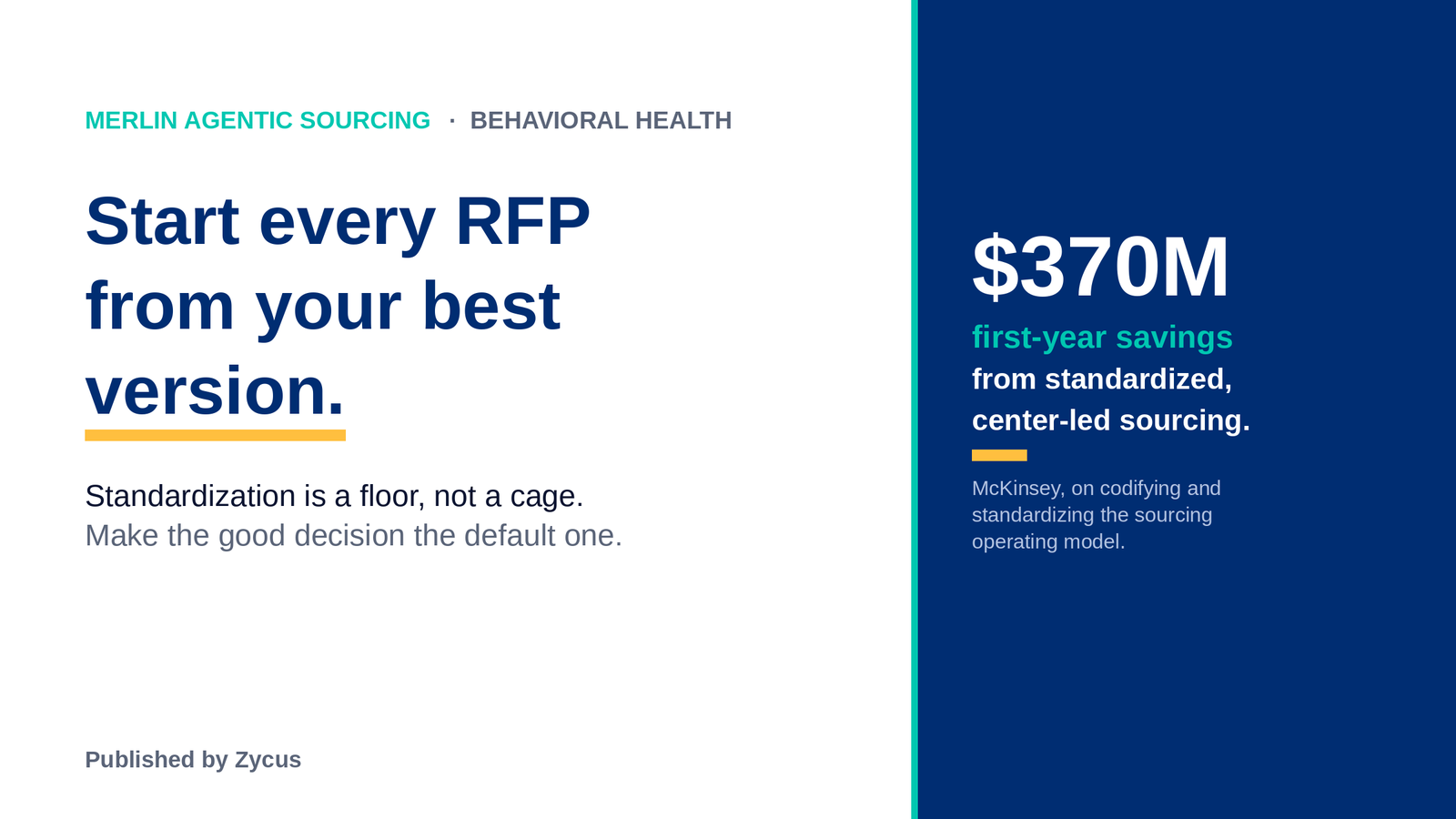
It changes where value comes from. McKinsey’s research on procurement operating models shows that centralizing and standardizing sourcing through a center of excellence is one of the largest available levers: a specialty chemicals company saved 13% on raw materials by standardizing a should-cost approach, and an industrials organization reached $370 million in first-year savings after codifying its methods and elevating that discipline to the executive level. The mechanism is repeatability. When the good approach is written down and reused, it stops depending on individual heroics and starts compounding across every event the team runs.
Standardization is not the enemy of value. It is how value scales past a single talented category manager. The uncomfortable implication is that a team relying on individual talent is one departure away from a drop in sourcing quality, whereas a team relying on a codified standard is not. This is why standardization tends to show up in the numbers only at scale: a single well-run event looks the same either way, but a hundred of them do not.
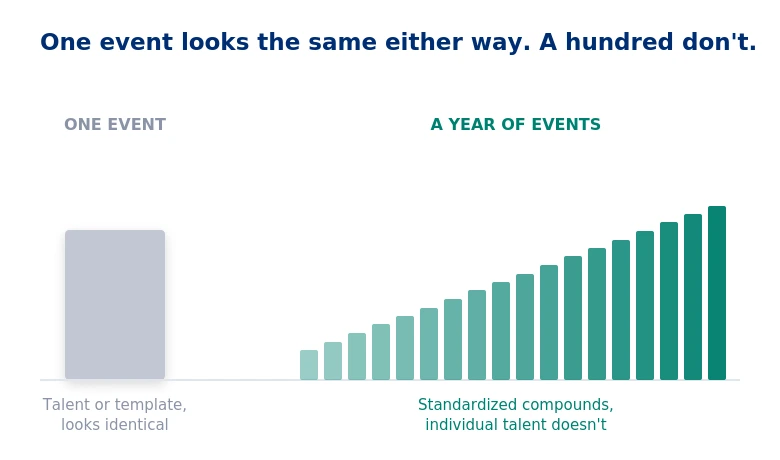
Figure 1. Standardization is nearly invisible on a single event and decisive across a year of them: the reused good version compounds, while individual talent does not.
What makes behavioral health procurement different from a generic template?
The requirements that a generic template quietly omits. Behavioral health sourcing carries licensure and credentialing checks that must be verified, not assumed. It carries privacy obligations that go beyond ordinary data handling. It often carries continuity-of-care considerations, where a change of provider is not a neutral event for the people being served. A template built for office supplies or IT hardware has no place for these, so a buyer working from the wrong template either leaves them out or bolts them on inconsistently.
A behavioral health template makes them mandatory fields, so no event can advance without addressing them. That is the difference between a form and a safeguard. These are not optional refinements in behavioral health; they are the difference between an RFP that protects the people being served and one that quietly exposes them. A template that treats these as ordinary fields, or omits them, is not merely incomplete; it is a template that can let a non-compliant award through without anyone noticing until it matters.
How do you keep a template from going stale?
Treat it as living, not frozen. The failure mode of standardization is a template written once, never updated, and eventually worked around because it no longer matches reality. The fix is a feedback loop: after each major event, capture what worked and what the buyer had to change, and fold the good changes back into the template. That way the standard improves rather than ossifies. A living template gets better every time it is used, because each event is a small test of it. A frozen template gets worse every quarter, because the world moves and it does not. The small ongoing cost of maintaining the template is trivial next to the cost of a standard that has silently drifted out of step with how sourcing actually needs to work.
How does agentic sourcing build standardization into the RFP itself?
By authoring the event from proven playbooks rather than from a blank page. Merlin Agentic Sourcing creates the RFP, the pricing table, and the evaluation structure from proven playbooks, so the standard is applied at the moment of creation instead of being a checklist a buyer is trusted to follow afterward. Where behavioral health requirements such as licensure or continuity clauses belong, they are part of the generated structure rather than an afterthought.
Because it is a pre-launch product, its speed figures are design-intent, so treat them as the mechanism rather than a promised number. The relevant point for standardization is not speed anyway. It is that the good version becomes the automatic starting point for every event, which is exactly what a standard is supposed to guarantee. Because the requirements are generated into the event rather than appended to it, there is no separate step for a busy buyer to forget, which is the usual point of failure for a written standard.
Does standardization limit the buyer’s judgment?
Only if it is built badly. A good template standardizes the parts that should not vary, the required questions, the scoring method, the mandatory clauses, and leaves room for the parts that should, the category-specific detail and the trade-offs a skilled buyer weighs. The aim is to free judgment, not replace it. When the buyer is not spending effort rebuilding the scaffolding every time, that effort goes to the decisions that actually need a human: which trade-offs matter for this service, which supplier truly fits.
Standardization handles the reproducible parts so judgment can concentrate where it earns its keep. In practice, the buyers who feared standardization most often become its strongest advocates, once they see it doing the tedious scaffolding they never wanted to redo by hand. The buyer still owns the trade-offs that make each event particular; what changes is that they no longer spend that judgment rebuilding the parts that should have been settled once and reused.
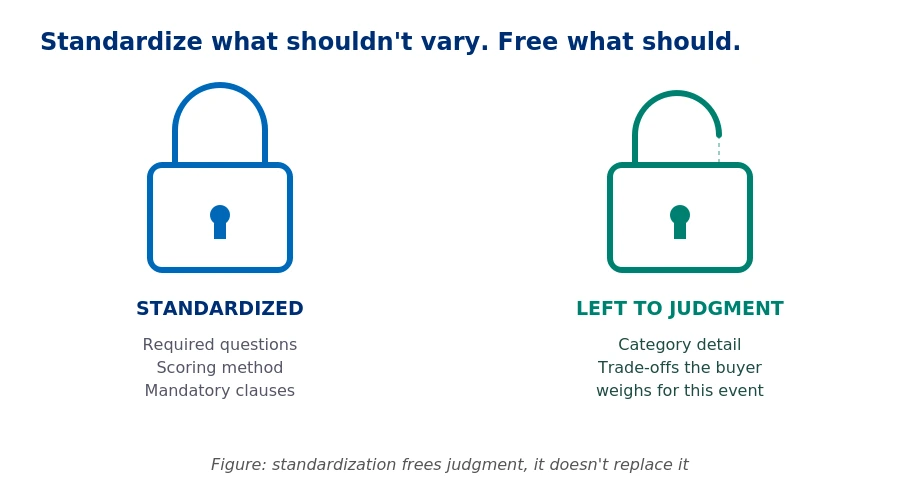
Figure 2. Standardize what should not vary (required questions, scoring method, mandatory clauses) and leave what should to the buyer (category detail and the trade-offs of each event).
How do you roll a standardized template into a team that resists it?
Introduce it as a starting point, not a straitjacket. Resistance usually comes from buyers who fear a form will override their expertise, so show them the template captures their best practice rather than someone else’s rules. Seed it from the team’s own strongest past events, so it reads as familiar. Let them improve it, so they own it. And measure the result: more consistent RFPs, fewer omitted requirements, faster starts. When the standard visibly makes their work easier and their awards more defensible, adoption follows, because the compliant path has become the easy one. Adoption is finally a design problem, not a compliance problem: build the standard so the easy path and the correct path are the same path, and resistance mostly dissolves.
Adopting standardized rfp templates transforms behavioral health sourcing from a disjointed administrative burden into a structured, audit-ready operational advantage. By standardizing evaluation frameworks upfront, health systems can mitigate regulatory risk, onboard specialized care providers faster, and keep the focus where it belongs – on patient outcomes.
Want standardization built into how RFPs are created? Merlin Agentic Sourcing authors events from your proven playbooks, so every RFP starts from your best version with the right requirements built in. It is part of the Merlin Agentic Platform, Zycus’s Intake-to-Outcomes architecture for governed, multi-agent procurement. Request a demo to see it applied to your categories.
Frequently Asked Questions
Q1. Why use standardized RFP templates in behavioral health procurement?
Because a standardized template makes required elements such as licensure, credentialing, privacy, and continuity of care mandatory rather than dependent on whoever runs the event. It raises the floor of quality for every RFP and removes the variance that comes from each buyer starting from a blank page or a random prior document.
Q2. Does standardizing RFPs reduce a buyer’s flexibility?
Not if built well. A good template standardizes what should not vary, such as required questions, scoring method, and mandatory clauses, while leaving room for category-specific detail and the trade-offs a skilled buyer weighs. It frees judgment for the decisions that need a human rather than replacing it.
Q3. What does standardization do for sourcing outcomes?
It makes value repeatable. McKinsey documents standardized, center-led sourcing driving large savings, including a 13% raw-materials reduction from a standardized should-cost approach and $370 million in first-year savings from codifying methods. Repeatability lets good practice compound across every event instead of depending on individual talent.
Q4. How do you keep an RFP template from becoming outdated?
Treat it as living. After each major event, capture what worked and what the buyer changed, and fold the good changes back in. A living template improves every time it is used, while a frozen one degrades as reality moves and eventually gets worked around.
Q5. What should a behavioral health RFP template always include?
Verified licensure and credentialing checks, privacy obligations beyond ordinary data handling, and continuity-of-care considerations, made mandatory fields so no event can advance without addressing them. A generic template omits these, which is why a behavioral-health-specific one matters.
Q6. How does Merlin Agentic Sourcing support standardized RFPs?
It authors the RFP, pricing table, and evaluation structure from proven playbooks, so the standard is applied when the event is created rather than as a checklist applied afterward. Required elements become part of the generated structure. As a pre-launch product, its speed figures are design-intent.
Q7. How do you get a resistant team to adopt a standard template?
Introduce it as a starting point seeded from the team’s own strongest past events, let them improve and own it, and measure the result. When the standard visibly makes their work easier and their awards more defensible, adoption follows because the compliant path has become the easy one.