





The right catalog model is not determined by habit or transaction volume alone. It depends on how dynamic the supplier data is, how complex the assortment is, what the supplier can support, and how much effort procurement can sustain over time.
TL;DR
- A punchout catalog sends the user from the procurement system into a supplier-hosted storefront and returns the selected cart for internal approval and purchase order creation.
- A hosted catalog keeps item data inside the procurement platform. Its freshness depends on how often the supplier or procurement team updates, syncs, or republishes that content.
- Punchout is often a better fit for large, frequently changing, or configurable assortments when the supplier has the integration capability to support it.
- Hosted catalogs are often a better fit for controlled, negotiated assortments where centralized search, governance, and lower integration effort matter more than a live supplier storefront.
- Transaction volume matters, but it should not decide the model by itself. Data volatility, configuration needs, supplier readiness, integration economics, and governance matter just as much.
- A hybrid model can be the right answer. Procurement does not have to force an entire category into one catalog type.
- Zycus supports unified search across more than 1,200 punchout and hosted catalogs, including Amazon Business and Mercateo, through Merlin Intake and catalog management workflows.
Punchout and hosted catalogs solve the same broad procurement problem: make approved buying easier and keep purchases inside governed channels. They solve it in different ways, which is why choosing between them should be a design decision rather than a platform default.
The most useful question is not “Which catalog type is better?” It is “Which model keeps this supplier content accurate, usable, and economical to maintain?” That shifts the conversation away from habit and toward the operating conditions that actually determine whether a procurement catalog keeps working six or twelve months after launch.
What is the difference between a punchout catalog and a hosted catalog?
A punchout catalog is a live, interactive supplier catalog that users access from the procurement application. The shopping session takes place on the supplier site, and the selected cart is returned to the buyer’s requisition or purchasing workflow. Punchout commonly uses cXML, although other integration methods such as OCI are also used in enterprise procurement environments.
A hosted catalog stores the supplier’s item data inside the procurement platform. The buyer searches and selects products without leaving that environment. Hosted does not necessarily mean “manual spreadsheet” or “permanently static.” Catalog content can be refreshed through supplier portals, file uploads, cXML or CIF catalog feeds, and other integrations. The key difference is where the shopping content lives and how updates reach the procurement system.
That distinction affects data freshness, user experience, search behavior, integration effort, catalog governance, and supplier maintenance. It is more accurate than reducing the choice to “live versus static.”
Punchout vs hosted catalog at a glance
| Dimension | Punchout catalog | Hosted catalog | Decision signal |
|---|---|---|---|
| Content location | Supplier-hosted storefront | Stored inside procurement platform | Where should the shopping experience live? |
| Pricing and availability | Retrieved from the supplier during the session | Current as of the latest update or sync | How quickly does supplier data change? |
| Assortment complexity | Strong fit for large or configurable assortments | Strong fit for controlled, standardized assortments | How hard is the content to maintain centrally? |
| Integration effort | Usually higher per supplier connection | Usually lower to moderate, depending on update method | Can the supplier support and maintain the connection? |
| Search experience | May open a supplier storefront; Level 2 punchout can improve item discovery | Items can be searched directly in the procurement platform | Do users need cross-supplier comparison in one interface? |
| Governance | Buyer policies still apply after cart return; supplier controls storefront content | Buyer has tighter control over loaded content and visibility | Who should own content governance? |
| Best-fit pattern | Dynamic, configurable, broad assortments with capable suppliers | Stable, contracted, curated assortments with predictable updates | Which model minimizes total operating effort? |
The table is a decision aid, not a hard rule. A high-volume category can work well as hosted if the assortment is stable and update automation is strong. A lower-volume supplier can justify punchout when configuration complexity makes a hosted catalog difficult to maintain.
How does a punchout catalog work?
A typical punchout procurement flow has five steps:
- The requester starts inside the buyer’s procurement or guided buying experience.
- The system authenticates the user into the approved supplier storefront, often using cXML PunchOut or another supported integration method.
- The requester searches, configures, and adds items on the supplier site using the buyer-specific assortment and pricing available there.
- The cart returns to the procurement system as requisition lines rather than being purchased directly on the supplier site.
- Internal policy checks, approvals, purchase order creation, receiving, and invoicing continue inside the buyer’s normal procure-to-pay workflow.
The cXML standard defines the widely used PunchOutSetupRequest and related transaction messages that make this exchange possible. Punchout changes where the shopping session occurs, not where procurement governance ends.
When does a punchout catalog make sense?
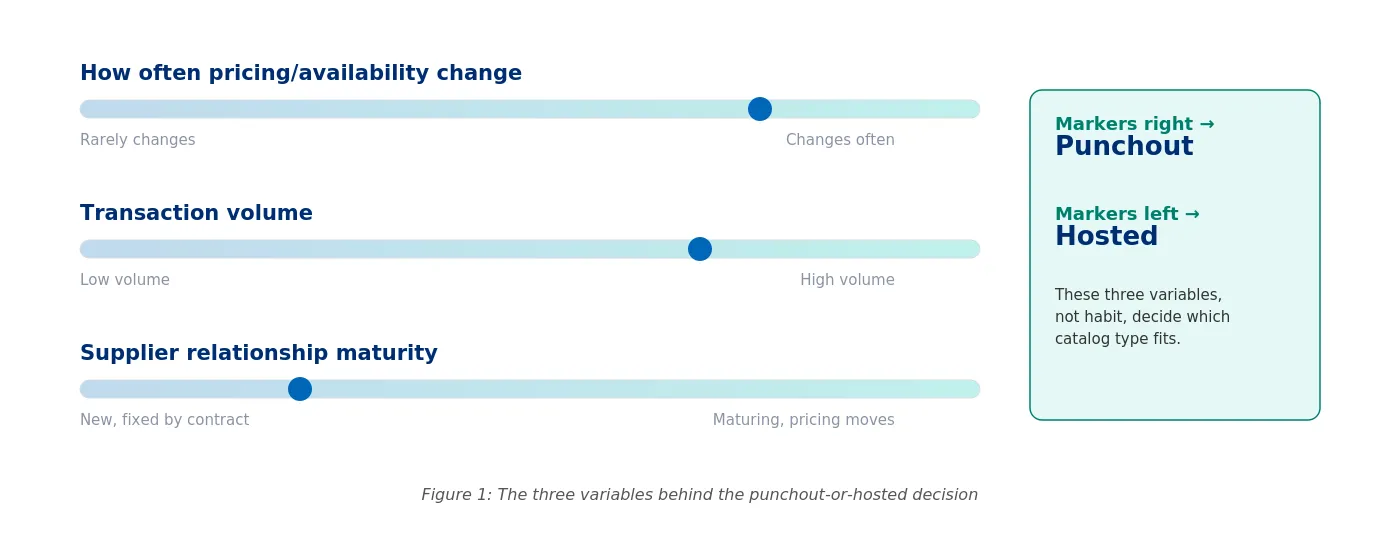
Punchout usually becomes attractive when keeping a replicated catalog inside the procurement platform would create more maintenance than value. Typical signals include frequent price or availability changes, a very large SKU base, configurable products, rapidly changing technical specifications, or a supplier storefront that already provides a strong B2B shopping experience.
IT hardware, MRO, lab supplies, industrial components, and facilities products often fit this pattern, but category labels are only shorthand. The real question is whether the supplier data changes fast enough, or is complex enough, that maintaining another copy of it creates avoidable work and mismatch risk.
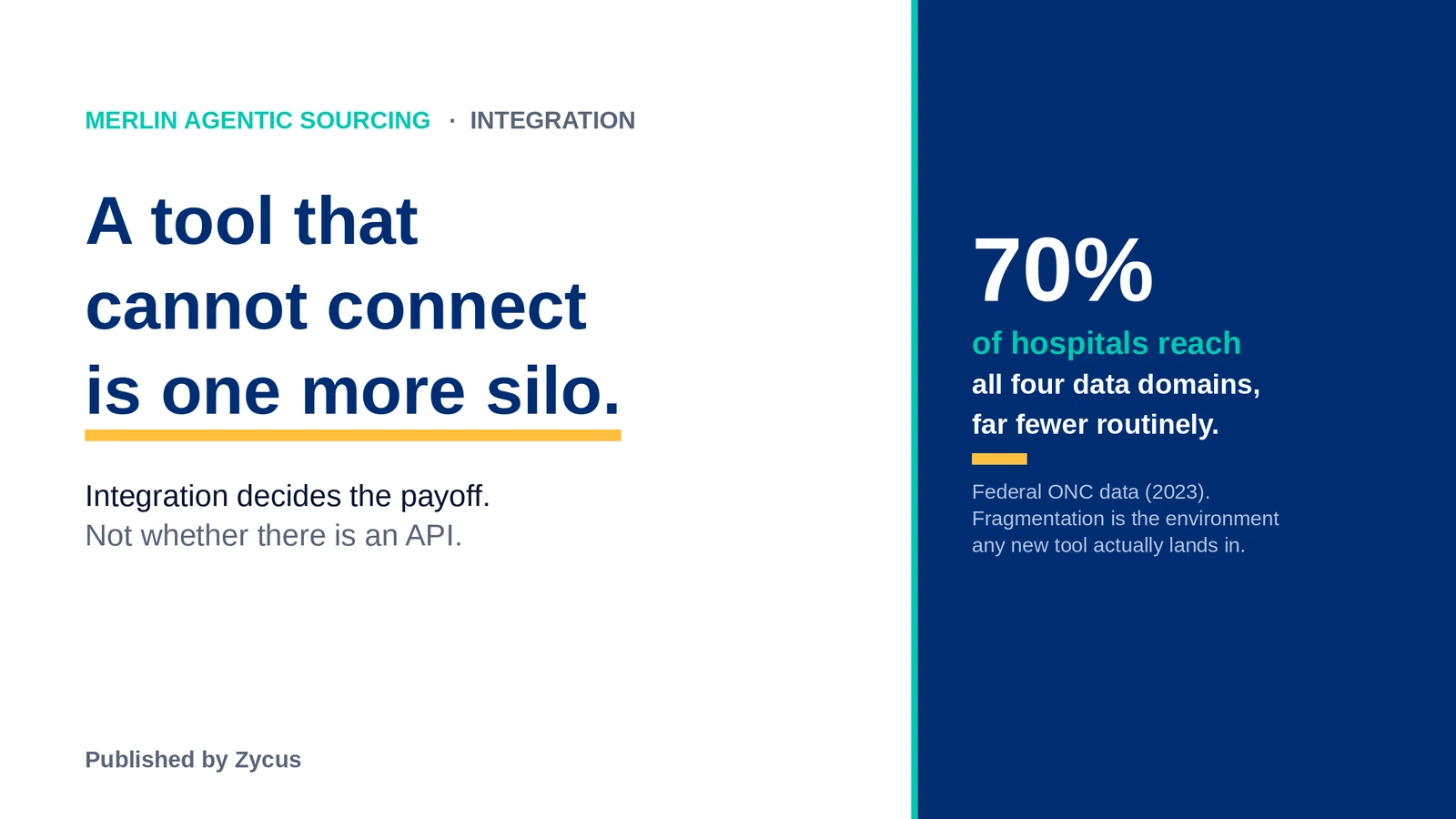
The tradeoff is integration. Each supplier needs the technical capability and operational discipline to support the punchout connection. The business case improves when the connection removes recurring content maintenance, reduces manual data entry, or handles configurations that would otherwise generate exceptions.
When does a hosted catalog make sense?
Hosted catalogs work well when procurement wants a controlled assortment inside one search experience and the underlying data can be kept accurate without a live supplier storefront. Examples include negotiated office supplies, standard consumables, approved rate cards, or predictable goods where the item list and commercial terms do not change constantly.
A hosted model can also be useful when a supplier does not support punchout, when procurement wants tighter control over which items are visible, or when cross-supplier comparison inside the procurement platform matters more than a supplier-specific shopping experience.
Its main risk is not that hosted content is inherently stale. The risk is weak update governance. A hosted catalog with disciplined supplier self-service, automated feeds, or scheduled refreshes can stay highly accurate. A neglected catalog, regardless of format, will eventually create friction.
What happens when the catalog model no longer fits?
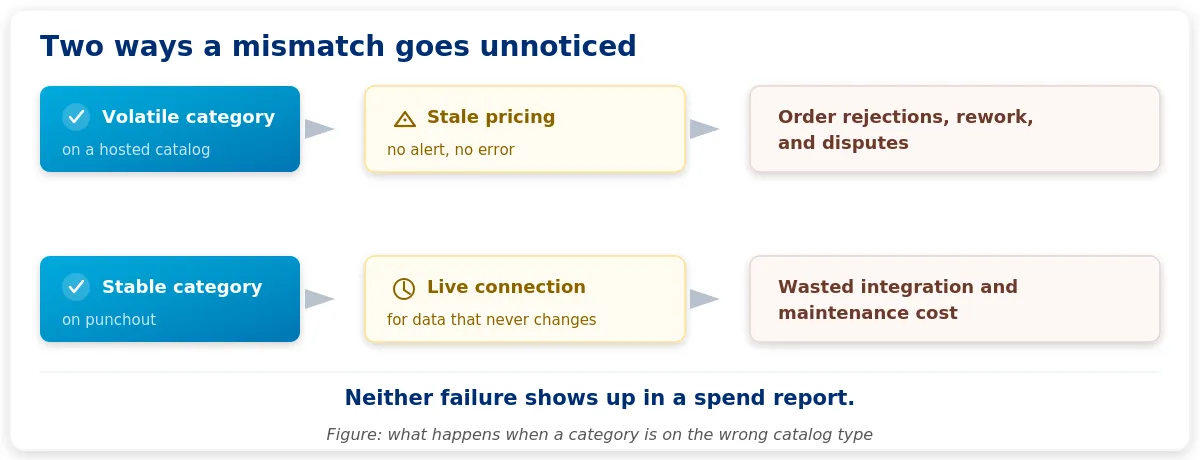
Catalog problems rarely arrive as a system failure. They show up as operational noise: price corrections, rejected order lines, unavailable SKUs, repeated catalog update tickets, search failures, or buyers leaving the approved channel because the catalog no longer reflects what they need.
For a hosted catalog, recurring price and availability mismatches can be a sign that the update cadence is no longer keeping up with the supplier. For a punchout connection, recurring integration tickets or low usage can signal that the live connection is costing more to maintain than the buying pattern justifies.
The important point is not to diagnose every mismatch as “wrong catalog type.” First check the underlying cause. Contract data, supplier configuration, taxonomy, search quality, user permissions, and approval design can create similar symptoms. Catalog type should be reconsidered when the pattern persists after those basics are working.
A five-question framework for choosing the catalog model
Before setting up a supplier or renewing an existing catalog design, procurement can run five questions. The answers usually make the tradeoff clearer than category labels do.
| Question | Leans toward punchout | Leans toward hosted |
|---|---|---|
| 1. How fast do price, availability, and product details change? | Frequent changes | Predictable changes |
| 2. How complex is the assortment or configuration? | Large, dynamic, configurable | Curated, standardized |
| 3. Can the supplier reliably support punchout integration? | Yes, mature B2B capability | No, limited integration support |
| 4. Where is the lower long-term maintenance burden? | Supplier should maintain live storefront data | Buyer can efficiently govern catalog content |
| 5. What shopping experience best supports adoption? | Supplier site adds real value | Centralized search and comparison matter more |
Transaction volume belongs inside question four because volume changes the economics of integration and maintenance. It should influence the decision but not override the other four questions.
Can one category use both punchout and hosted catalogs?
Yes. A hybrid model can be more sensible than forcing a category into one format. A category may use hosted catalogs for a controlled set of standard items and punchout for suppliers with broad, configurable, or fast-changing assortments. The split can also occur supplier by supplier rather than item by item.
What matters is that users do not have to understand the architecture. The procurement experience should help them find the approved option, while procurement retains one view of policy, spend, approvals, and supplier usage across catalog types.
How does Zycus support punchout and hosted catalogs?
Zycus catalog management software supports both models and provides cross-catalog search across more than 1,200 punchout and hosted catalogs, including Amazon Business and Mercateo, through Merlin Intake and Microsoft Teams. The platform supports cXML, CIF, XLSX, and CSV catalog configurations, along with supplier self-service and catalog update workflows.
That changes an important part of the user experience. Procurement can choose the appropriate catalog model for each supplier or buying scenario without asking the requester to understand the difference. The buying front door can search or route into the approved catalog path while the underlying catalog governance remains with procurement.
This is different from claiming that the platform should make the catalog-strategy decision on its own. Procurement still needs to decide which model fits the supplier relationship, content, commercial terms, and integration economics. Technology should reduce the friction of using that strategy, not replace the strategy itself.
The Hackett Group’s 2026 AI World Class Procurement benchmarks reported a 110 percent improvement in guided buying and catalog adoption among AI World Class organizations, alongside 69 percent less maverick spend leakage. The benchmark does not prescribe punchout or hosted. It does reinforce the business value of making approved catalog channels easier to use and harder to bypass.
When should procurement revisit the catalog type?
Catalog design should be revisited when the operating conditions change, not only when something breaks. Useful trigger points include contract renewal, a major supplier-system change, rapid assortment growth, a move to dynamic pricing, recurring catalog update failures, persistent order corrections, low catalog adoption, or a sharp increase in integration support tickets.
A simple category review can ask: Has the supplier content become more dynamic? Has the assortment become harder to maintain centrally? Is the punchout connection being used enough to justify its support cost? Are users still finding the right items through the approved channel? If the answers have shifted, the original catalog choice may need to shift too.
Which metrics show whether the catalog strategy is working?
- Catalog adoption: share of addressable purchases completed through approved catalogs.
- Price discrepancy rate: frequency of requisition or invoice corrections caused by catalog pricing mismatches.
- Order rejection or substitution rate: how often catalog items cannot be fulfilled as requested.
- Catalog freshness: time since the last successful content update, sync, or supplier refresh.
- Search success: share of catalog searches that lead to an approved item or supplier without a manual workaround.
- Maintenance effort: procurement and supplier hours spent on catalog updates, integration incidents, and content correction.
- Off-catalog and maverick spend: purchases that bypass the governed buying channel despite catalog coverage.
These measures make the decision observable. Instead of debating catalog formats in the abstract, procurement can see whether the chosen model is keeping content current, users compliant, and maintenance effort proportionate to the spend it supports.
The decision is not punchout versus hosted. It is fit versus friction.
The best catalog strategy is the one that keeps approved buying accurate and easy without creating more maintenance than the category deserves. Punchout is valuable when a live supplier experience removes content complexity. Hosted is valuable when procurement can govern a stable assortment more efficiently inside its own platform. Hybrid designs are valuable when the category needs both.
That is the decision worth revisiting over time. Catalog types are infrastructure choices, but their success is measured in everyday outcomes: current prices, findable items, fewer workarounds, cleaner requisitions, and higher use of the buying channels procurement already negotiated.
Merlin Intake works as part of the Merlin Agentic AI Platform, so this kind of split does not require two disconnected systems each reporting spend differently. The routing logic and the policy engine are shared across both catalog types, which means a split category still rolls up into one compliance and spend view instead of two separate ones that someone has to manually reconcile at month end.
Frequently Asked Questions
Q1. What is a punchout catalog?
A punchout catalog is a supplier-hosted storefront launched from a buyer’s procurement system. The user shops on the supplier site and returns the cart to the procurement workflow for approvals and purchase order processing.
Q2. What is the main difference between a punchout and a hosted catalog?
Punchout keeps the shopping content on the supplier site and returns a cart to the procurement system. A hosted catalog stores the supplier item data inside the procurement platform and updates it through uploads, feeds, supplier portals, or other supported methods.
Q3. Which is better, punchout or hosted catalogs?
Neither is universally better. Punchout often fits dynamic or configurable assortments and suppliers with mature B2B integration. Hosted often fits stable, controlled assortments where centralized search and lower integration effort are more valuable.
Q4. Does punchout always provide accurate real-time pricing?
Punchout retrieves the supplier’s current session data, but accuracy still depends on the supplier storefront, contract-price mapping, and integration configuration. A live connection does not eliminate the need for governance.
Q5. Does punchout always use cXML?
No. cXML is a widely used punchout standard, but enterprise environments can also use OCI and other supported integration methods depending on the procurement platform and supplier.
Q6. Can hosted catalogs be automated?
Yes. Hosted catalogs can be updated through supplier self-service, scheduled file feeds, catalog integrations, and platform workflows. They do not have to rely on manual spreadsheet uploads.
Q7. Can a category use both hosted and punchout catalogs?
Yes. Procurement can use different catalog models within the same category when supplier capabilities and assortment characteristics differ. The key is to keep the user experience and governance consistent across both.
Q8. How many catalogs does Zycus support in unified search?
Zycus supports unified search across more than 1,200 punchout and hosted catalogs, including suppliers such as Amazon Business and Mercateo, through Merlin Intake and Microsoft Teams.